





Send PostHog event data to Slack webhooks
Contents
Use this destination to send custom messages into Slack based on PostHog events or actions.
If you want to receive regular insight or dashboard subscriptions to Slack, checkout our subscriptions docs.
Requirements
Using this requires a PostHog Cloud account, access to an active Slack account, and permissions to add the PostHog bot to the Slack workspace and channel.
Installation
1. Create a new destination
First, you need to create a new destination in PostHog that will send the event data to Slack. To do this:
Start in PostHog, click the Data pipeline tab in the left sidebar.
Click the Destinations tab.
Click the + New destination button and search for
Slack, then click + Create.
2. Configure a source
Select a source that will trigger messages to be sent to Slack. To do this:
- Under Source, select if events or person updates will trigger messages to be sent to Slack.
- Update the filters to specify which events or person updates will trigger messages to be sent to Slack.
- Update the Trigger options to specify if the messages should be sent immediately or on a schedule.
💡 You can also try clicking the icon to create filters with PostHog AI.
3. Add the PostHog Slack app to your workspace
Next, connect your Slack workspace to PostHog by clicking Choose Slack connection. If you already have a Slack connection, you can select it from the dropdown, and continue to the next step.
If you don't have a Slack connection, you can click Connect to Slack to create a new one. You will be redirected to Slack to install the PostHog app.
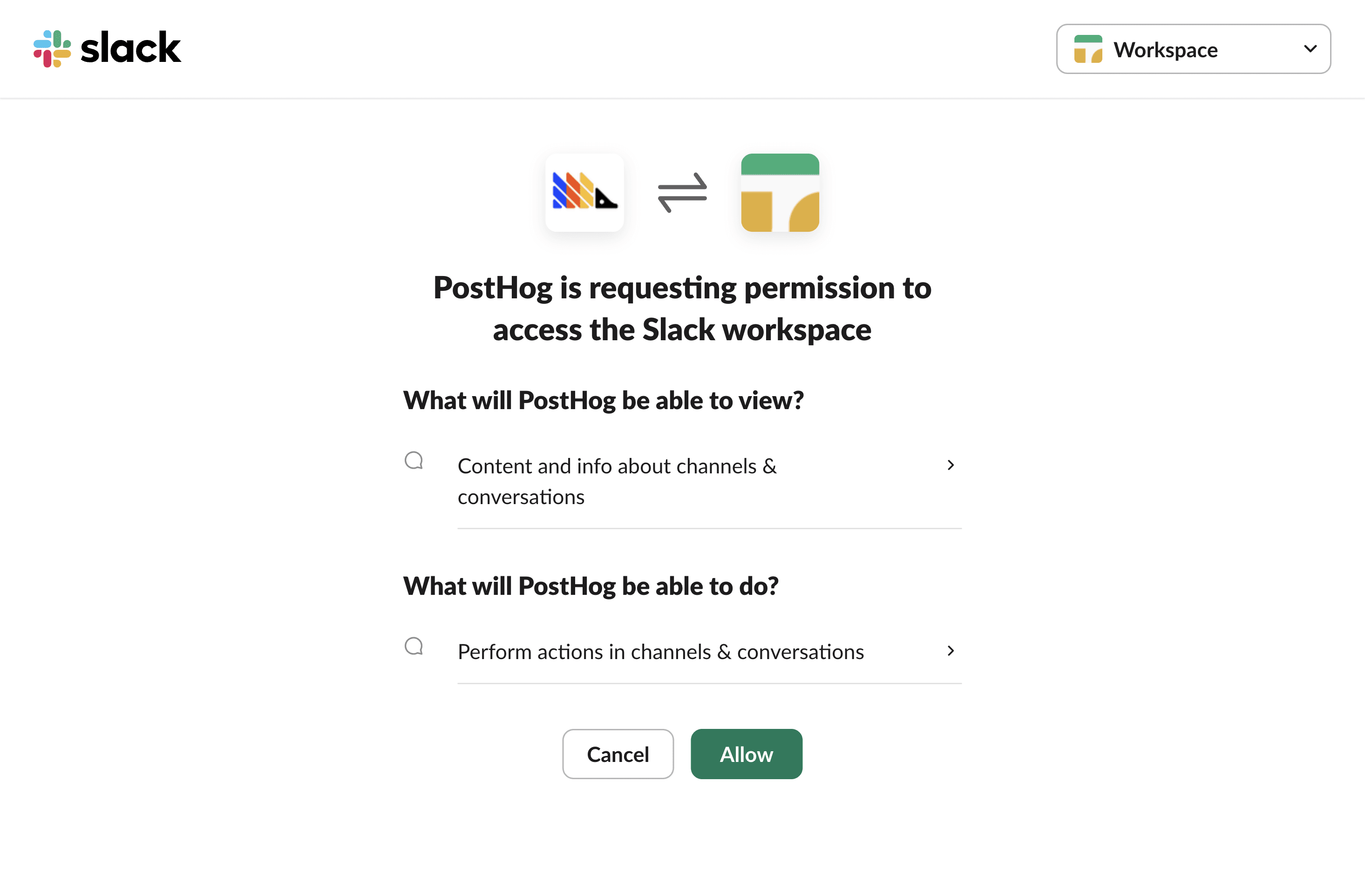
The PostHog Slack app will require some basic permissions which you can grant by clicking the Allow button.
4. Add the PostHog Slack app to your channel
You also need to configure which Slack channel will receive the messages from PostHog. To do this, add the PostHog app to the channel you want to send messages to:
- In the Slack channel header, click the top right menu and click Open channel details
- Navigate to the Integrations tab
- Click the Add an app button
- Under In your workspace, click PostHog
Once you've added the PostHog app to your workspace, you can select it under Channel to post to in the destination editor.
5. Template your message
Finally, you can template your message using Slack's block kit or as a plain text message. You can template the message with the event and person properties using the \{\} syntax. For example:
Once done, press Create & Enable and watch your messages appear in Slack.
You can see a full example of this in our tutorial on how to send survey responses to Slack
Configuration
FAQ
Why can't I see all my Slack channels in the dropdown?
Slack integrations will only show channels that the authorizing user has access to.
I have a lot of slack channels and loading all in the dropdown fails, how can I set a slack channel?
If you have thousands of slack channels, the slack API might rate limit you before the dropdown can load all channels.
In this case, you can manually paste a slack channel id into the field to load just that one by id. If it is found, you can then select and use it.
Is the source code for this destination available?
PostHog is open-source and so are all the destination on the platform. The source code is available on GitHub.
Who maintains this?
This is maintained by PostHog. If you have issues with it not functioning as intended, please let us know!
What if I have feedback on this destination?
We love feature requests and feedback. Please tell us what you think.
What if my question isn't answered above?
We love answering questions. Ask us anything via our community forum.