







The 9 best GDPR-compliant analytics tools


Contents
The GDPR (General Data Protection Regulation) places significant restrictions on how you can use tools like Google Analytics to track and collect user data.
And, while there is no universal legal definition of what constitutes "GDPR-compliant analytics", there are some fundamental principles you can follow:
You must acquire "unambiguous consent": Tucking a notice away in your terms and conditions isn't enough. This is why cookie banners are a thing. You need user consent if you're collecting personally identifiable information.
Data must be handled securely: GDPR punishes breaches of privacy and security severely. Data must be held securely and staff trained in how to handle data. You must also delete any personal data you hold if a user requests it.
Only collect data you actually need: The GDPR encourages organizations to only collect information they actually need. A free online newsletter, for example, needs a user's email address and basic information, such as their name and what country or city they live in, but it doesn't need their home or work address.
Until recently, storing personal data on EU citizens in the US was also considered a potential breach of the GDPR, but a new adequacy decision agreed in July 2023 makes this less problematic. It's still good practice to avoid transferring this data if you can, but it's not a breach provided US-based companies participate in the new EU-US Data Privacy Framework.
The best GDPR-compliant analytics tools
There are numerous ways to achieve GDPR compliance, which you can broadly categorize as good, better or best:
- Good: Data transferred to the US is anonymized
- Better: Data is stored in EU cloud servers
- Best: You self-host and control all data / no personal data is collected
All the tools in this list offer one or more of these methods. We've also chosen a broad range of tools that includes in-depth product analytics platforms, lightweight "privacy first" platforms and open source Google Analytics alternatives.
| Tool | Best for | EU hosting | Self-host | Cookieless | Free tier |
|---|---|---|---|---|---|
| PostHog | Product teams and startups | ✔ | ✔ | ✔ | 1M events |
| Plausible | Simple websites | ✔ | ✔ | ✔ | None |
| Umami | Privacy-first sites | ✖ | ✔ | ✔ | 100k events |
| Fathom | Multi-site agencies | ✔ | ✖ | ✔ | None |
| Matomo | GA replacement | ✔ | ✔ | ✔ | Self-host only |
| Vercel | Vercel users | ✖ | ✖ | ✔ | 50k events |
| Countly | Mobile apps | ✔ | ✔ | ✖ | Self-host only |
| TelemetryDeck | iOS/Android apps | ✔ | ✖ | ✔ | 100k signals |
| GoAccess | Sysadmins | ✔ | ✔ | ✔ | Unlimited |
1. PostHog
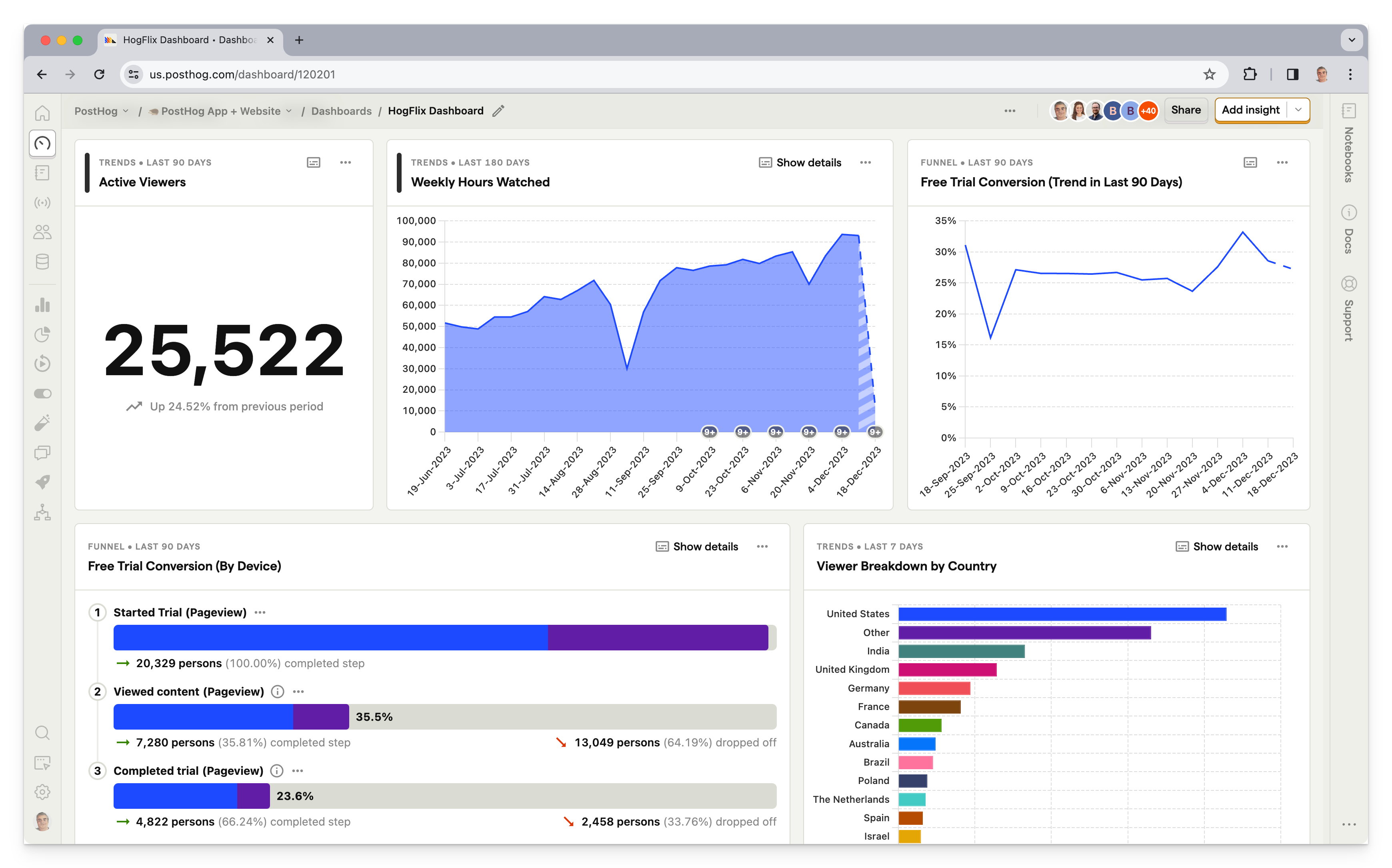
PostHog is an all-in-one, open-source developer platform that combines product analytics, web analytics, error tracking, session replay, feature flags, surveys, and experimentation into a single platform. Think Amplitude + Hotjar + LaunchDarkly in one.
PostHog offers EU data hosting, so you can keep all your user data within the EU to comply with the GDPR. Hobbyists can also self-host PostHog Open Source via Docker Compose, though this is only recommended for smaller event volumes in the ~100k per month range. PostHog also supports event autocapture, so you can start collecting useful data immediately without instrumenting events by hand.
Who is PostHog for?
PostHog is especially helpful for engineers and product teams that want to understand how users use their product. It's great for early-stage startups, but the powerful tool set and range of integrations means it scales to suit any business size.
Features & benefits
- An all-in-one developer tool suite
- EU data hosting available
- Feature flags, A/B testing, heatmaps, [session recording(/docs/session-replay) and more
- A Data Warehouse and CDP
- Unlimited ability to scale
- Open source, via MIT license
PostHog and GDPR compliance
- Open Source: ✔
- Self Hosting: ✔
- EU Cloud Hosting: ✔
- Cookieless Tracking: ✔
Smaller projects can self-host PostHog Open Source using Docker Compose, but PostHog Cloud EU, a fully-managed service with servers hosted in Frankfurt, Germany, is the best option for most users.
While PostHog uses cookies by default, it can be configured not to use cookies. With cookieless server hash mode enabled, PostHog measures visitors using a privacy-preserving hash generated on its servers. The hash changes daily, and PostHog does not store a distinct ID in the visitor's browser.
How much does PostHog cost?
PostHog Cloud is free to use up to 1 million events per month, plus 5,000 web and 2,500 mobile recordings. Paid plans include support for multiple projects, and advanced features like A/B and multivariate testing, correlation analysis, cohorts and group analytics.


Install PostHog with one command
Paste this into your terminal and make AI do all the work.

2. Plausible
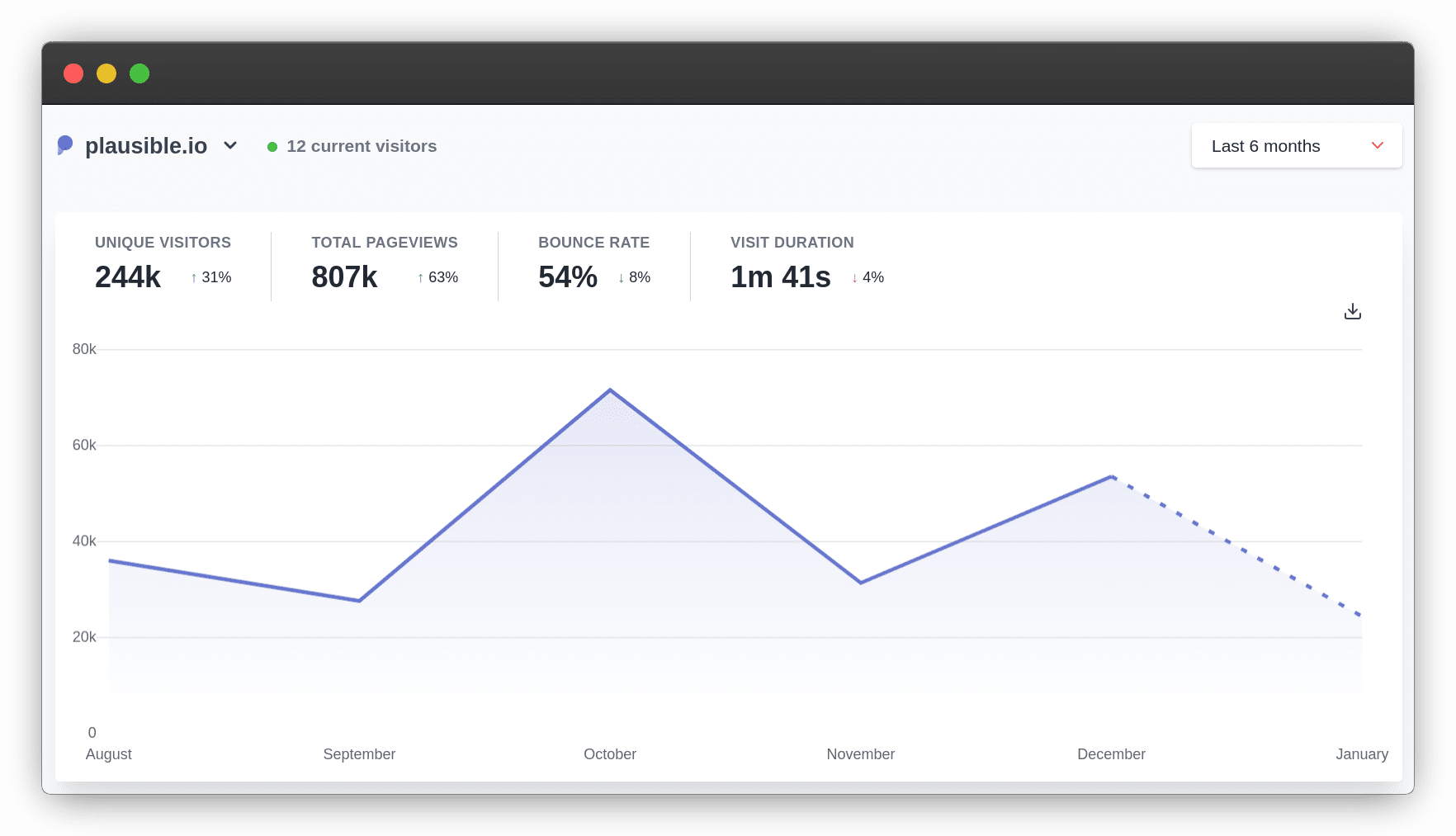
Plausible is a lightweight alternative to tools such as Google Analytics. It offers an effective way to track simple web metrics, such as page views and the number of unique visitors, but lacks the depth of a full product analytics platform.
Plausible’s lightweight nature does offer several benefits however, such as a small script size which means it has a minimal impact on page performance. This further distinguishes it from the bloat of Google Analytics.
Plausible’s intense focus on privacy makes it an attractive option for individuals, but also imposes restrictions on how data can be used and stored. There’s no way to identify users or track behavior across multiple sessions or devices, for example.
Who is Plausible for?
Plausible is a good fit for small content and marketing teams who need to track simple website metrics, or for freelancers and bloggers who only need to monitor small sites.
Features & benefits
- Lightweight script with minimal page speed impact
- No need for any cookies, at all
- Minimal data collection for users
- No tracking across sessions, devices or sites
Plausible and GDPR compliance
- Open Source: ✔
- Self Hosting: ✔
- EU Cloud Hosting: ✔
- Cookieless Tracking: ✔
Plausible is made and hosted in the EU. It collects no personally identifiable information at all, making it ideal if you want basic, GDPR-compliant analytics.
How much does Plausible cost?
Plausible charges by pageview with 1 million pageviews costing $69 per month. Paying annually grants you two free months per year – i.e. $69 per month becomes $690 per year. The open source version is free to self-host via Docker Compose.
3. Umami
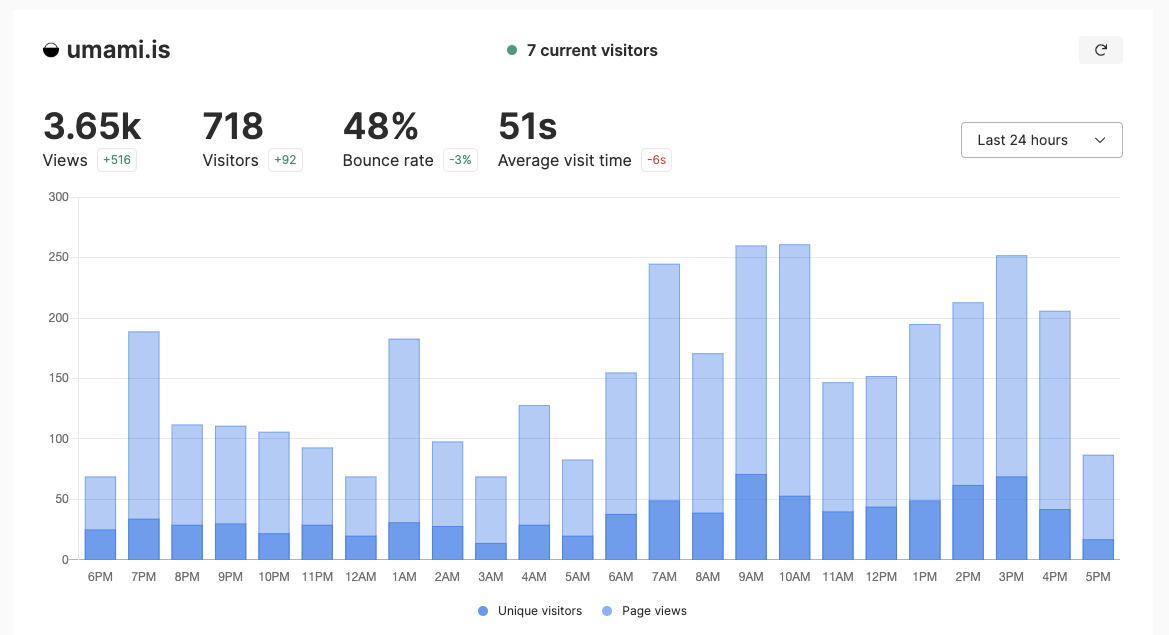
Umami is an increasingly popular open-source analytics tool designed for privacy. Like Plausible, it's easy to self-host and collects no personal information (such as IP addresses) making GDPR compliance easy. The downside, as usual with privacy-first analytics tools, is it only collects basic analytics data, so it's best used for website analytics where you're less concerned with understanding user behavior.
Who is Umami for?
Privacy-conscious website owners who want a no-frills solution that doesn't impact website performance.
Features and benefits
- Self-hosting cookieless tracking
- Lightweight script with no performance impact
- Basic event tracking for buttons and other UI elements
Umami and GDPR compliance
- Open Source: ✔
- Self Hosting: ✔
- EU Cloud Hosting: ✖
- Cookieless Tracking: ✔
How much does Umami cost?
Umami has a free tier that includes 100k monthly events. 1 million events is $20 per month; additional events require a custom Enterprise quote.
4. Fathom
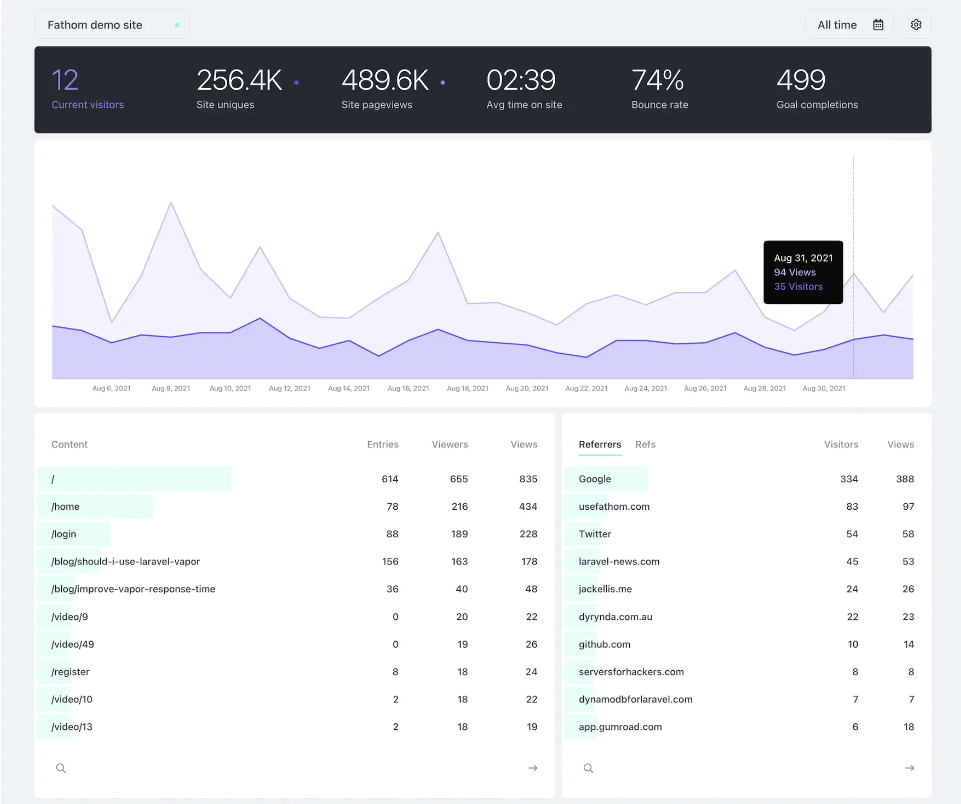
Fathom is a popular, privacy-friendly alternative to Google Analytics that's built with user privacy at its core. It tracks common web statistics like unique visitors, page views, time on site, bounce rate, and referral data. It also has a basic event tracking system for measuring things like downloads, mailing list signups, and purchases.
While based in Canada, Fathom offers EU-hosting. It also employs what it calls intelligent routing. This ensures that non-EU users are routed via its US servers, while EU users are routed via its EU-based and owned servers. Fathom claims this means non-EU visitors get better performance compared to other, similar services that use EU-only hosting.
Who is Fathom for?
Fathom is ideal for individual users and companies who only require basic web analytics. Unlike GA and other more advanced alternatives, such as PostHog or Matomo, Fathom is a simple, single-page application. It tracks all the basic analytics most people need, but can't offer much insight into user behavior. It's also useful for agencies as it supports up to 50 websites on its core pricing plans.
Features & benefits
- Fast and lightweight tracking script
- No cookie banner required
- EU isolation and intelligent routing
- Email reports
- Multi-domain tracking
Fathom and GDPR compliance
- Open Source: ✖
- Self Hosting: ✖
- EU Cloud Hosting: ✔
- Cookieless Tracking: ✔
As a privacy-first solution, Fathom is GDPR compliant out-of-the-box with no compromises. It's also a cookie-less solution, so you don't need cookie banners when using it.
How much does Fathom cost?
Like Plausible, Fathom charges by pageview, though it's a bit cheaper than Plausible. A website generating 1 million pageviews per month would pay $60 per month, compared to around $69 with Plausible. Fathom also offers two months free use for paying annually, but there is no free-to-use open source version (just a 7-day free trial of the cloud version).
5. Matomo

Matomo is one of the most popular Google Analytics alternatives because it enables teams to collect a comparable level of information, but can be deployed on-premises so that you don’t need to share information with third-parties. Like PostHog, it’s also open source.
One of Matomo’s most appealing features is the ability to import existing Google Analytics data into Matomo when getting started, so that you don’t lose any previous insights.
Matomo offers a wealth of other features, from custom alerts to tag managers and media analytics, though many of these are sold under per-feature subscriptions which can make the cost of on-premise deployments hard to predict.
Who is Matomo for?
Matomo is suitable for businesses of all sizes which need an alternative to Google Analytics. The cloud version of Matomo is also easy to setup, making it ideal for non-technical users.
Features & benefits
- Cloud hosting on European servers
- Self-hosting version available
- All-in-one Google Analytics replacement
- Google Analytics importer
- Open source, via GPL 3.0
Matomo and GDPR compliance
- Open Source: ✔
- Self Hosting: ✔
- EU Cloud Hosting: ✔
- Cookieless Tracking: ✔
Matomo offers first-party cookies by default and robust tools to ensure personally identifiable information (PII) is anonymized. Additionally, it can be deployed either on-premises, or into EU-based cloud servers. Yes. Matomo offers the option of cookie-less tracking, though this does reduce the quality of data it collects.
How much does Matomo cost?
Matomo's core open source analytics is free to self-host. More advanced features, such as A/B testing and Custom reports, are add-ons charged for annually at varying rates. Its managed cloud service charges by hits (any pageview, event, download etc.) with 1 million hits costing £139 (approx. $170) per month.
Related: PostHog and Matomo compared
6. Vercel Web Analytics

Vercel includes a lightweight, privacy-compliant analytics tool in all its front-end-as-a-service plans. Like most privacy-first tools, it tracks basic website metrics like pageviews, unique users, time on page, and referrers. You can also set up custom events you want to track (e.g. clicking a call to action). It records no personally identifiable information, so you can use it without cookie permission banners. It also includes a useful Speed Insights tool for keeping track of your website's Web Vitals.
Who is Vercel Web Analytics for?
While it's only available to Vercel customers, Vercel Web Analytics is ideal if you just need basic website analytics – e.g. for a company website. It does everything Plausible, Fathom and other privacy-first tools offer, so you don't need to deploy them if you're already using Vercel.
Features & benefits
- Included with Vercel
- Tracks all key website metrics
- Supports custom events
- No cookie banners needed
Vercel Web Analytics and GDPR compliance
- Open Source: ✖
- Self Hosting: ✖
- EU Cloud Hosting: ✖
- Cookieless Tracking: ✔
Vercel doesn't support hosting your analytics data in the EU, but it collects no personally identifiable information, so this isn't necessary for GDPR compliance.
How much does Vercel Web Analytics cost?
Free hobby deployments include up to 50,000 events per month. The Pro plan charges $3 per 100,000 additional events (or $0.00003 per event) and includes custom events; for an additional $10/month per team, you can extend usage and capabilities through the Web Analytics Plus add-on, which includes UTM parameters and a longer reporting window.
7. Countly

Like PostHog, Countly is an extendable product analytics platform that offers self-hosted open source and enterprise editions, or cloud deployments, for organizations that want to understand product performance and user journeys in greater detail.
Countly offers a robust suite of features and an extensive range of integrations, including a Net Promoter Score (NPS) survey plugin. The ability to track crashes and errors, and to issue push notifications to mobile users, are also useful additions over most other analytics tools.
Who is Countly for?
Countly's range of features make it particularly attractive to mobile app developers, especially those working on multi-platform apps across iOS, Mac, Windows, and Android. Its open source Community Edition is available on a AGPL v3 license, though this version removes the majority of its user behavior features, such as retention, revenue tracking, user tracking, cohorts, funnels, and user flow.
Features & benefits
- Support for mobile, web, desktop and IoT devices
- Extensible via plugins
- Self-hosting (AGPL v3) and private cloud deployments available
- Push notifications and crash analytics
Countly and GDPR compliance
- Open Source: ✔
- Self Hosting: ✔
- EU Cloud Hosting: ✔
- Cookieless Tracking: ✖
Like PostHog, Countly can be deployed onto your own infrastructure, or in cloud servers based in the EU, so that data isn't stored in servers outside of GDPR jurisdiction. It doesn't offer a cookie-less tracking option, but it does have consent systems built in.
How much does Countly cost?
The Flex plan (private cloud) starts at $175/month with usage-based pricing and a 14-day free trial. The Enterprise plan requires a custom quote.
Its open source Community Edition is free to self-host, but it excludes most of its user behavior features.
8. TelemetryDeck

TelemetryDeck is to app analytics what Plausible and Fathom are to website analytics – a lightweight tool that collects minimal personal information. Consequently, TelemetryDeck says developers can use it without tracking permission banners.
Unlike Plausible and Fathom, TelemetryDeck is an event-based analytics platform, making it more adept at understanding what users are doing in your app. It includes basic retention, funnel, page flow insights, and tracks useful app data such as app version, phone model and OS version, and average usage time.
Who is TelemetryDeck for?
TelemetryDeck is good for individual app developers who want a simple, effective solution for app analytics. It's most comparable to Countly, though it doesn't collect as much information on users, or offer as many features. There are first-party SDKs for Swift, Kotlin (for Android and Java), and Javascript (for Node and websites). There's also a community SDK for the Unity game engine.
Features & benefits
- App analytics for Android and iPhone apps
- Doesn't track any personally identifiable information
- Tracks app version and phone OS version
- Basic retention, funnel, and user path visualizations
TelemetryDeck and GDPR compliance
- Open source: ✖
- Self-hosting: ✖
- EU Cloud Hosting: ✔
- Cookieless Tracking: ✔
TelemetryDeck makes GDPR compliance very easy. It doesn't collect enough personal information to require opt-out banners, and it's hosted in the EU.
How much does TelemetryDeck cost?
TelemetryDeck's free plan gives you up to 100,000 signals per month – signals are TelemetryDeck's name for events. It offers 20% discount for annual plans, and has transparency pricing up to 500M signals for month; additional signals would require a custom quote.
9. GoAccess
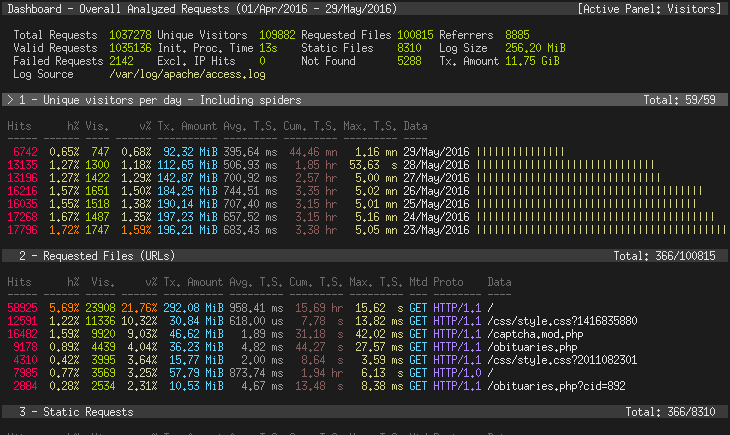
GoAccess is a completely open source web log analyzer and viewer which runs in a browser-based terminal to give you an overview of the most common website metrics. This means it can act as a replacement for tools such as Google Analytics, though it falls short of a product analytics platform in capabilities.
Functioning in real-time, GoAccess is useful for spotting who is using up your bandwidth and identifying aggressive crawlers or bots, as well as tracking site metrics such as page views, visitors and time-on-page. The toolset, design and reliance on a terminal make it a popular choice for sysadmins.
Who is GoAccess for?
GoAccess is for system administrators and software engineers who need to track web performance across smaller sites. It’s unsuitable for those needing a self-service analytics platform or who need easy integration with other tools or data warehouses.
Features & benefits
- Open source, via MIT license
- Completely real-time tracking
- Customizable dashboards
- Runs inside a terminal or browser
GoAccess and GDPR compliance
- Open Source: ✔
- Self Hosting: ✔
- EU Cloud Hosting: ✔
- Cookieless Tracking: ✔
You can configure GoAccess to either not collect IP addresses or anonymize them, so it can be used without cookie banners.
How much does GoAccess cost?
GoAccess is open source and has no paid tiers.
Which GDPR-compliant analytics tool should you choose?
- Want an all-in-one platform with analytics, session replay, feature flags, and EU hosting? Go with PostHog.
- Need simple website metrics with zero personal data collection? Plausible or Fathom keep it minimal.
- Building mobile apps and need privacy-first analytics? TelemetryDeck is purpose-built for iOS and Android.
- Looking for a direct Google Analytics replacement you can self-host? Matomo imports your GA data.
- Already using Vercel? Their built-in Vercel Web Analytics covers the basics.
- Sysadmin who lives in the terminal? GoAccess analyzes server logs directly.
Install PostHog with one command
Paste this into your terminal and make AI do all the work.
Frequently asked questions
PostHog says it makes your product "self-driving" – what does that mean?
It means PostHog digs through your product data, finds what's worth fixing, and has agents do the work.
It starts with context. A full suite of developer tools – AI Observability, Product Analytics, Session Replay, Feature Flags, Experiments, Error Tracking, Logs, and more – captures everything happening in your product, and a Context Warehouse unifies it into one source agents can read across.
From there, Scouts read across all of it and sort what's worth knowing from what's just noise. What clears the bar becomes a report in your inbox: an agent picks it up, roots out the cause, and opens a PR. You review and merge.
You can steer it from Slack, the web app, or your own editor via the MCP or CLI.
Is Google Analytics GDPR compliant?
Google Analytics can be configured for GDPR compliance, but it requires effort. You need cookie consent banners, IP anonymization, and data processing agreements. Several EU data protection authorities have ruled against GA4 implementations, making alternatives like PostHog, Plausible, or Matomo safer choices for EU-focused businesses.
Do I need cookie consent banners with GDPR-compliant analytics?
Not always. Tools like Plausible, Fathom, and TelemetryDeck collect no personally identifiable information, so they don't require consent banners. PostHog and Matomo can be configured for cookieless tracking, which also removes the banner requirement – though this limits some tracking capabilities.
What's the difference between EU hosting and cookieless tracking?
EU hosting means your data is stored on servers within the European Union, which satisfies GDPR data residency requirements. Cookieless tracking means no cookies are set on user devices, eliminating the need for consent banners. They solve different problems – you might want both, or just one, depending on your compliance needs.
Which GDPR-compliant analytics tool is best for product teams?
PostHog is the best choice for product teams. It combines a full suite of developer tools, including product and web analytics, all with EU hosting. Matomo and Countly also offer product analytics features, but PostHog's all-in-one approach means fewer tools to manage.
Which is best for simple website analytics?
Plausible and Fathom are both excellent for basic website metrics. They're lightweight, collect no personal data, and don't require cookie banners. Plausible is open source if you want to self-host; Fathom offers intelligent routing for better global performance.
Can I use GDPR-compliant analytics without self-hosting?
Yes. PostHog, Plausible, Fathom, Matomo, and TelemetryDeck all offer managed cloud hosting with EU data residency. Self-hosting is optional – it gives you maximum control but isn't required for GDPR compliance.
What's the best free GDPR-compliant analytics tool?
PostHog offers the most generous free tier for product analytics: 1 million events, 5,000 web and 2,500 mobile session replays per month with EU hosting. For simple website analytics, Umami offers 100k events free, and GoAccess is completely free and open source (though it requires self-hosting).
Is Amplitude GDPR compliant?
Amplitude offers EU data residency and SOC 2 certification, so it can be configured for GDPR compliance. However, it's not privacy-first – you'll still need cookie consent banners. If GDPR compliance is a priority, consider PostHog as an alternative with similar features plus transparent pricing.

Subscribe to our newsletter
build mode
Read by 75,000+ founders and builders
We'll share your email with Substack
PostHog is your product's context layer. With a full suite of developer tools – AI observability, product analytics, session replay, feature flags, experiments, error tracking, logs, and more – PostHog ingests and stores all the data agents need to diagnose problems, uncover opportunities, and ship fixes. A data warehouse and CDP tie it all together, unifying that context into one source agents can read across. You can steer it all from Slack, the web app, the desktop (PostHog Desktop), or your own editor via the MCP.