







The best Matomo alternatives & competitors, compared


Contents
Matomo is a well-established, privacy-first analytics platform. It's open source, self-hostable, and a natural migration path for teams leaving Google Analytics (especially those who preferred the old Universal Analytics, RIP).
But it's not for everyone. It's primarily a web analytics tool, and while it has expanded over the years, teams often find themselves reaching for additional tools as their needs grow – whether that's deeper product analytics, simpler privacy-first tracking, or a more modern interface.
If you've outgrown it or just want to compare your options, here are the best alternatives.
1. PostHog
- Founded: 2020
- Similar to: Heap, Amplitude, Pendo
- Typical users: Engineers and product teams
- Typical customers: Mid-size B2Bs and startups
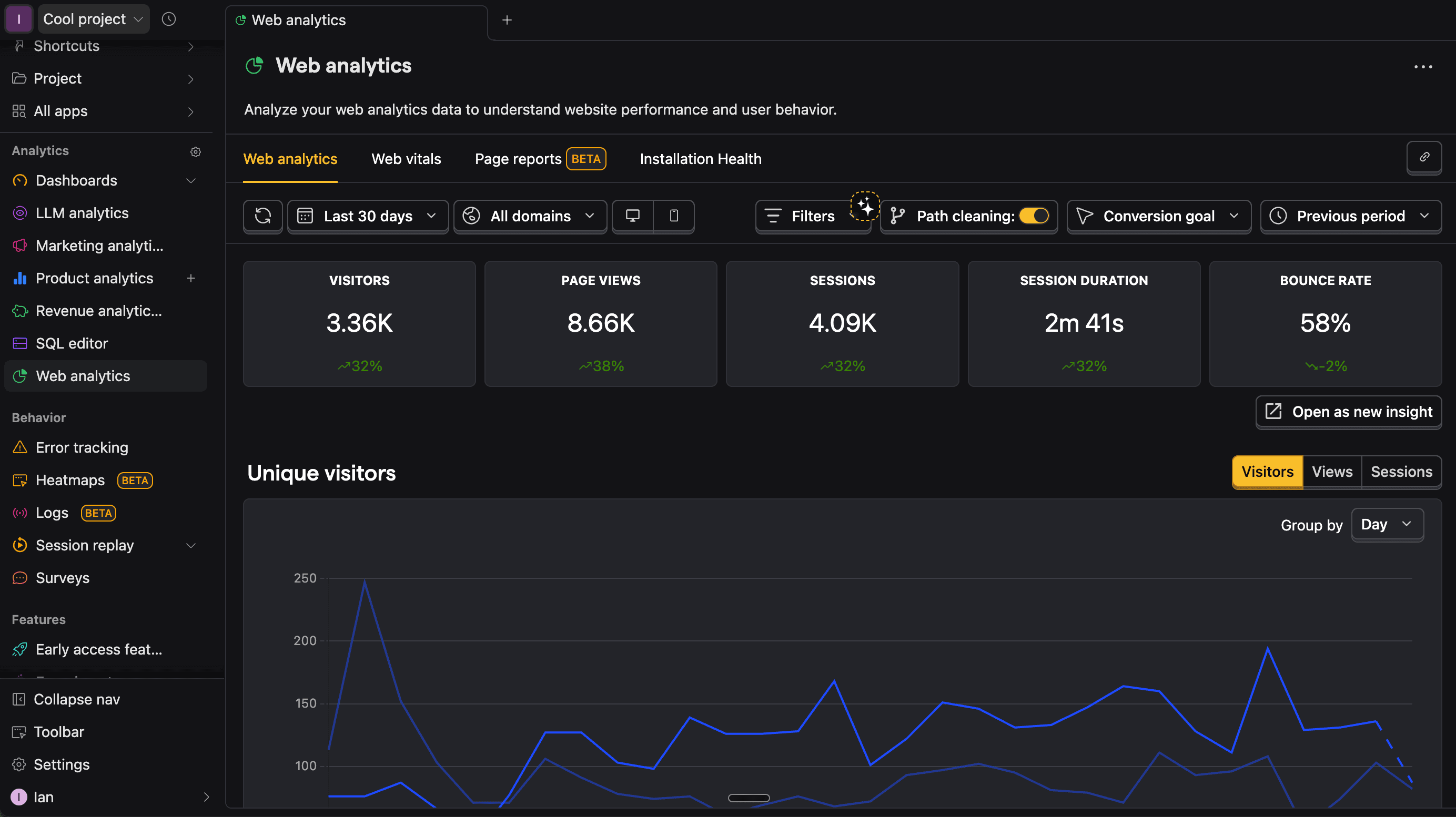
What is PostHog?
PostHog (that's us 👋) is an all-in-one developer platform combining web and product analytics, session replay, experiments, feature flags, error tracking, LLM observability, user surveys, and more into one product.
This means it's not only an alternative to Matomo but also tools like Mixpanel, Amplitude, Sentry, and LaunchDarkly.
Key features
Web analytics: Monitor your web traffic by automatically capturing and calculating metrics like visitors, pageviews, session duration, and bounce rate. See the sources, entry and exit paths, channels, and more.
Product analytics: Custom trends, funnels, user paths, retention analysis, and segment user cohorts. Also, direct SQL querying for power users.
Session replays: View exactly how users are using your site. Includes event timelines, console logs, network activity, and 90-day data retention.
A/B tests: Optimize your app and website with up to nine test variations and track impact on primary and secondary metrics. Automatically calculate test duration, sample size, and statistical significance.
Error tracking: Monitor exceptions, connect errors directly to session replays and feature flag changes.
LLM observability: Track model performance, token costs, latency, and user interactions for AI-powered products. See our full AI engineering suite.
How does PostHog compare to Matomo?
Both PostHog and Matomo are multi-product platforms. The big difference between them is that Matomo focuses on websites and content, while PostHog focuses on apps and products.
Another big difference is pricing. Matomo's session replay, heatmaps, and A/B testing are paid add-ons in On-Premise, and heavily capped in Cloud. PostHog includes all of these on its free tier – plus feature flags, error tracking, AI Observability, and more that Matomo doesn't offer at all.
Main differences between PostHog and Matomo
- Matomo has a Google Analytics importer for migrating historical GA3 and GA4 data; PostHog does not have a direct GA importer.
- PostHog is entirely usage-based with a generous free tier; Matomo Cloud is subscription-based and On-Premise requires paid plugins for most advanced features.
- PostHog has an official MCP server for AI coding tools; Matomo's MCP options are third party community projects, not officially maintained by Matomo.
- PostHog is HIPAA-ready on Cloud; Matomo Cloud cannot be made HIPAA compliant, just the self-hosted On-Premise version can.
- PostHog includes a built-in data warehouse for importing and querying data from sources like Stripe, HubSpot, and S3 alongside your analytics. Matomo can export to BigQuery but has no warehouse import or unified query layer.
Main similarities between PostHog and Matomo
- Both offer EU data hosting for GDPR compliance
- Both support cookieless tracking
- Both can replace Google Analytics for standard web analytics use cases
- Both have strong privacy-first positioning and data ownership guarantees
Why do companies use PostHog?
According to reviews on G2, companies use PostHog because:
It replaces multiple tools: PostHog can replace Matomo (web and product analytics), Fullstory (session replay), and GrowthBook (feature flags and A/B testing). This simplifies workflows and ensures product data is all in one place.
Pricing is transparent and scalable: Reviewers appreciate how PostHog's pricing scales as they grow. There's a generous free tier they can use forever. Companies eligible for PostHog for Startups also get $50k in additional free credits.
They need a complete picture of users: PostHog includes every tool necessary to understand users and improve products. This means creating funnels to track conversion, watching replays to see where users get stuck, testing solutions with A/B tests, and gathering feedback with user surveys.
Bottom line
Because PostHog has a significant amount of overlap with Matomo and a generous free tier, it makes a great alternative. This is especially true for product and engineering focused teams.


Install PostHog with one command
Paste this into your terminal and make AI do all the work.

2. Piwik Pro
- Founded: 2013
- Similar to: Matomo, Google Analytics
- Typical users: Marketing and analysis teams
- Typical customers: European enterprises in strict regulatory situations
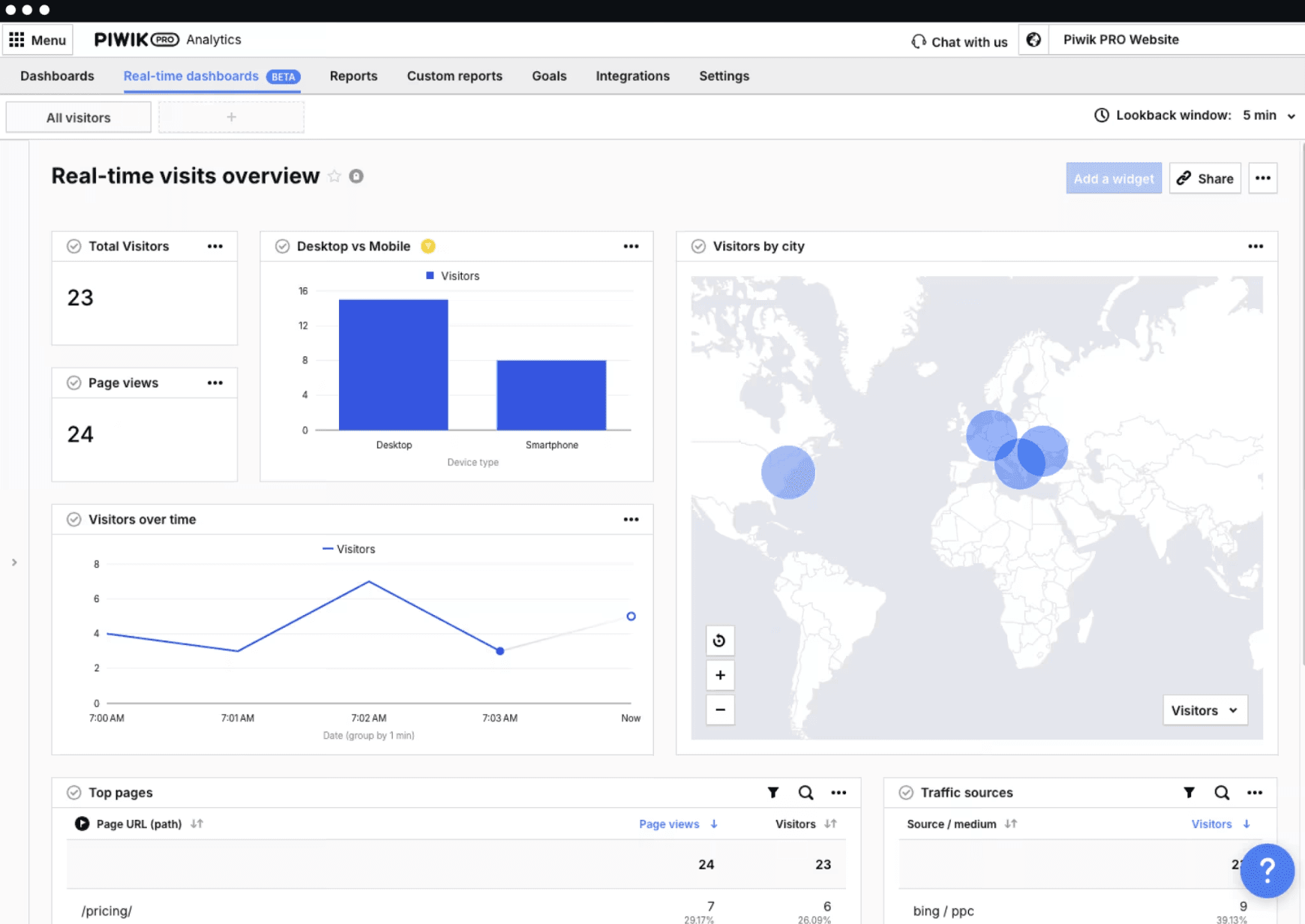
What is Piwik Pro?
Piwik Pro is a suite of privacy respecting analytics tools. It spun out of Matomo in 2013.
Features include web, mobile, and product analytics as well as tag and consent management. It is targeted at users in a strict regulatory environment. It also has integrations with a range of marketing and content management tools like Google Search Console, Google Ads, and Wordpress.
Key features
Analytics: Create custom dashboards with trends, charts, flows, funnels, and more to analyze your analytics.
Tag manager: Manage tags, pixels, and JavaScript snippets from a range of platforms.
Consent manager: Collect and manage consent to track and use personal information. Customize and tailor banners for different situations.
Customer data platform: Integrate with other tools and capture data to have it all in one place. Send data from Piwik Pro to other tools.
How does Piwik Pro compare to Matomo?
Because Piwik Pro spun out of Matomo, they share a lot of similarities.
Since the split, Piwik Pro has grown to focus more on compliance and integration with other tools. This shows in some of the features it lacks, such as A/B testing and session replay. It also isn't open source.
Main differences between Piwik Pro and Matomo
- Piwik Pro includes built-in tag management and consent management; Matomo requires separate plugins for both.
- Piwik Pro offers a CDP for audience activation and third-party integrations; Matomo has no equivalent.
- Matomo includes A/B testing and session recording (as plugins); Piwik Pro has neither.
- Matomo is open source and fully self-hostable; Piwik Pro is closed-source.
- Piwik Pro signs a HIPAA BAA on Enterprise plans; Matomo Cloud cannot be made HIPAA compliant.
Main similarities between Piwik Pro and Matomo
- Both offer EU hosting and GDPR compliance
- Both have a GA3/Universal Analytics-style interface
- Both support web and mobile analytics
- Both integrate with Google Search Console and Google Ads
💡 Good to know: Piwik Pro discontinued its free Core plan in February 2026. Paid plans now start at €35/month (Business). Enterprise plans start at €4,392/year. There is a 30-day free trial.
Why do companies use Piwik Pro?
Based on reviews from G2, the following summarizes the reasons why users choose Piwik Pro:
GA-like: Google Analytics users find that the transition to Piwik Pro is an easy one thanks to their similar dashboards and data models.
Compliance: Those in strict regulatory environments appreciate how Piwik Pro provides many of the tools they need to stay compliant like tag and consent management.
Control: Reviewers like that they are in control of their data, tune it to their needs, and host it outside the US.
Bottom line
Because of its free tier and similar feature set, Piwik Pro is a solid alternative to Matomo. Teams in strict regulatory environments will find their tag and consent management tools particularly useful.
3. Plausible
- Founded: 2019
- Similar to: Google Analytics, Matomo
- Typical users: Small SaaS companies
- Typical customers: Privacy-focused indiehackers and founders
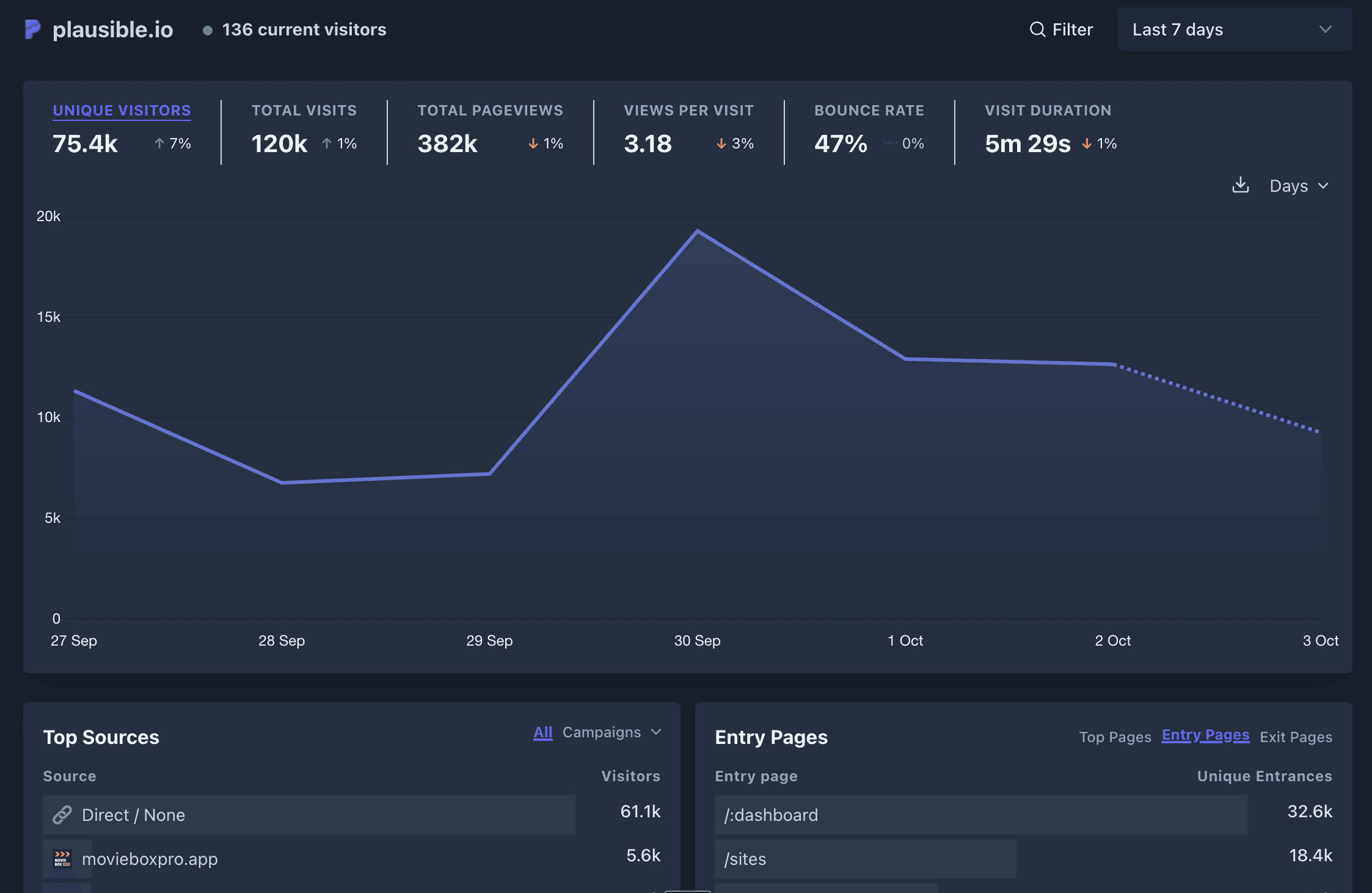
What is Plausible?
Plausible is a lightweight, privacy-friendly, EU-hosted Google Analytics alternative. It helps teams comply with regulations like GDPR and CCPA while still giving them the key traffic metrics they care about.
Plausible is also open source and self-hostable. This makes it a popular choice with indiehackers.
Key features
Traffic analysis: An overview of traffic, sources, sessions, and more in a simple, easy-to-understand dashboard.
EU hosting: Comply with regulations by storing all your data in the EU (and never having it leave).
Cookieless: Capture data about your traffic without needing cookies (or cookie banners).
Lightweight: Plausible's script is less than 1kB, making it significantly smaller than competitors.
How does Plausible compare to Matomo?
Plausible focuses entirely on web analytics. It has a simplified, privacy-focused feature set to do this. This means it lacks many of the more advanced product analytics features Matomo offers.
Main differences between Plausible and Matomo
- Plausible is cookieless by design; Matomo uses cookies by default (with a cookieless option).
- Plausible has no free tier – plans start at $9/month; Matomo On-Premise is free to self-host.
- Plausible has no session replay, heatmaps, or A/B testing; Matomo offers all three (as paid plugins on On-Premise).
- Plausible has a minimal single-page dashboard; Matomo has a multi-page GA-style interface with deeper reporting.
- Plausible's script is under 1KB; Matomo's is significantly larger.
Main similarities between Plausible and Matomo
- Both are open source and privacy-focused Google Analytics alternatives
- Both offer EU hosting and GDPR compliance without cookie consent banners
- Both track pageviews, referrers, UTM campaigns, and conversion goals
- Both integrate with Google Search Console for SEO keyword data
- Both support self-hosting for full data ownership
Why do companies use Plausible?
According to social media, users choose Plausible for the following reasons:
Simplicity: Plausible's paired down feature set makes it easier for bloggers, indiehackers, and smaller teams to get an understanding of their traffic.
Self-hostable: Many like that Plausible is self-hostable, meaning they are fully in control of their data and costs.
Privacy-focused: Privacy-conscious developers like they can still track their site while remaining compliant with regulations.
Bottom line
For teams looking for simple, privacy-focused web analytics, Plausible is a great choice. Those with advanced use cases will likely find Matomo or another tool suits them better.
4. Google Analytics
- Founded: 2005
- Similar to: Matomo, Piwik Pro
- Typical users: Marketing and business teams reliant on Google's ecosystem
- Typical customers: Small businesses and massive enterprises
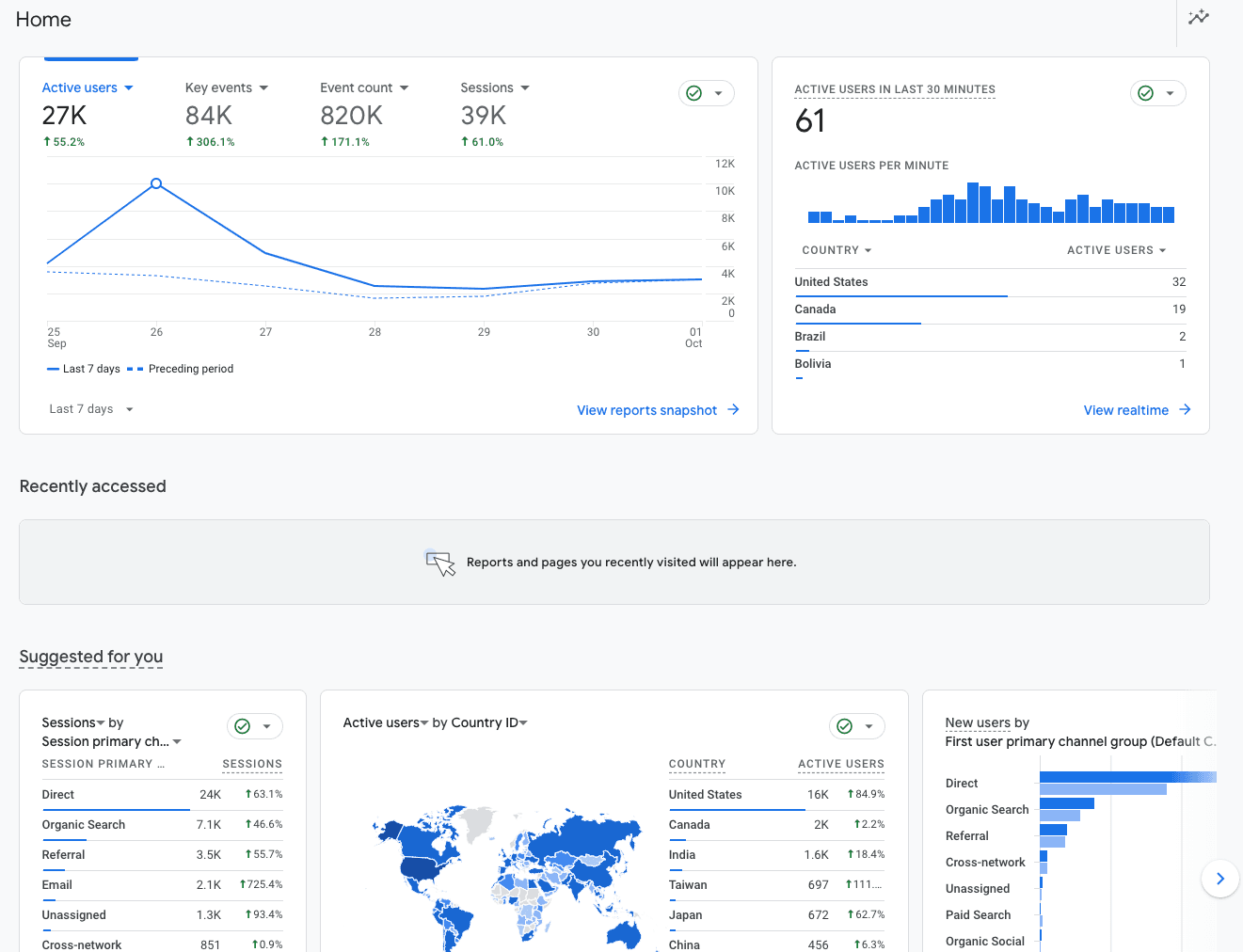
What is Google Analytics?
Google Analytics has long been the go-to choice for website and app analytics thanks to Google's huge market share, a large amount of informational content, and its connection with the rest of the Google suite.
Google Analytics switched from session-based Universal Analytics (GA3) to event-based GA4 – introducing conversion funnels and retention tables that product teams appreciate, but also a redesigned interface that frustrated many longtime users who preferred the old model.
Key features
Flexible reporting: GA has pre-built insights as well as fully customizable ones to fit your reporting requirements.
Predictive insights: Alert you to trends you're not aware of, like an increase in traffic to a specific landing page, or an anomalous decline in conversion from one period to another.
Integration with Google tools: It's easy to combine and analyze your GA4 data with tools like Looker Studio, Google Ads, BigQuery, and Firebase.
Natural language search: Ask specific questions, like "MoM growth in users on iOS", rather than searching existing reports.
Revenue metrics: Connect metrics to marketing spend and revenue conversion to get a full picture of ROI.
How does Google Analytics compare to Matomo?
Matomo was built explicitly as a privacy-respecting alternative to Google Analytics. It matches GA4's core web analytics features while adding full data ownership, no sampling, and stronger GDPR compliance. GA4 wins on Google ecosystem integration; Matomo wins on privacy and data control.
Main differences between Google Analytics and Matomo
- GA4 is event-based; Matomo is session-based like Universal Analytics, making it a more natural migration for UA users.
- Matomo can import historical data from Google Analytics; GA4 cannot import data from other tools.
- Matomo can be self-hosted for full data ownership; GA4 is cloud-only.
- Matomo doesn't sample data on any plan; GA4 applies sampling to large exploration queries.
- GA4 has a large free tier; Matomo's cloud is paid (free only for self-hosted).
Main similarities between Google Analytics and Matomo
- Both offer web analytics with traffic breakdown, referrers, and conversion tracking
- Both support custom event tracking and goal analysis
- Both support integrations with popular CMS and e-commerce platforms
- Both track UTM campaigns and marketing attribution
Why do companies use Google Analytics?
According to G2, users choose Google Analytics for:
Website traffic: The main use case reviewers praise GA for simply understanding their website's traffic, where it comes from, and what they do on the site.
Connection to marketing: Marketers like that it connects to marketing tools like Ads and Search Console. This helps them analyze the overall effectiveness and ROI of marketing efforts.
AI insights: Reviewers appreciate the fact that GA surfaces insights automatically and makes predictions. This helps them find new ways of improving their site.
Bottom line
You likely wouldn't consider Matomo without thinking about Google Analytics. It still has the best connections to the other Google tools and a huge user base. If you just need web analytics, it's a good choice.
5. Heap
- Founded: 2013
- Similar to: PostHog, Amplitude
- Typical users: Product and marketing teams
- Typical customers: B2C SaaS and ecommerce companies with a user experience focus.

What is Heap?
Heap describes itself as a digital insights platform. This means it offers both product analytics and session replay and supports marketing use cases with multi-touch attribution.
It's known for its visual event editor that lets non-technical teams tag and track events without engineering support.
Contentsquare acquired Heap and has been integrating the two products.
Key features
Event autocapture: Product teams don't need to rely on engineers to instrument all events. Heap has a visual editor for teams to tag events directly on-page for analysis.
Session replay: Get qualitative insights about user behavior by replaying their session - although this lacks the debugging tools typical of most replay tools.
Heatmaps: See where people click, what point they scroll to, and the areas that get the most attention.
Analysis suggestions: Advanced data science capabilities discover hidden interactions, friction points, and knowledge about key paths.
Managed ETL: Connect to data warehouses, so you can combine your analytics with other sources and get a fuller picture of the entire user journey.
How does Heap compare to Matomo?
Heap is focused on product analytics. It lacks a simple web analytics dashboard and is weaker on privacy, but stronger on autocapture, user journey analysis, and out-of-the-box data science features.
Main differences between Heap and Matomo
- Heap is focused on product analytics with autocapture and a visual event editor; Matomo is focused on web analytics with optional product analytics add-ons.
- Matomo is open source and self-hostable with EU hosting; Heap is closed-source with no EU data residency.
- Matomo includes ecommerce analytics and CMS integrations; Heap focuses on product and app behavior.
- Heap has no A/B testing or feature flags natively; Matomo has A/B testing.
Main similarities between Heap and Matomo
- Both offer session replay and heatmaps
- Both support custom event tracking and funnel analysis
- Both have cohort analysis for segmenting users
- Both integrate with data warehouses like Snowflake and BigQuery
Why do companies use Heap?
According to G2 reviews, companies enjoy these three areas of Heap:
Autocapture: Non-technical users love how easy autocapture makes tracking on their site. Along with the element data included, this provides a huge amount of useful analytics data with little setup.
Simple setup: It does not take a big technical effort to set Heap up. Users can add a single script and begin collecting data. They then make it easy to visualize that data through user paths, funnels, and session replays.
Streamlining analysis: By having analytics and session replay data in one place, Heap makes it easy to understand the usage of their app or site. This replaces interviews or user testing and makes the development cycle faster.
Bottom line
For product-focused teams, Heap's focus makes it a good choice. It does lack the breadth of features that Matomo offers though.
6. Amplitude
- Founded: 2012
- Similar to: PostHog, Pendo
- Typical users: Product managers, data analysts, marketing teams
- Typical customers: Mid-size and large enterprises

What is Amplitude?
Amplitude is one of the original product analytics tools. Many large enterprise customers, like Ford, NBCUniversal, and Walmart rely on it. In recent years, it also added A/B testing, session replay, and a customer data platform to its offering.
Key features
Product analytics: Funnel and retention analysis, user paths, behavioral cohorts, custom dashboards, and more.
A/B testing: Test new features on specific targets and analyze with primary, secondary, and counter metrics.
Customer data platform: Combine analytics data with third-party tools for data governance, identity resolution, and data federation.
AI insight builder: Generate insights based on natural language requests, like "What is my purchase conversion rate?".
Session replay: Reconstruct user sessions to understand how people interact with your site and app. Visualize the reality behind user journeys and metrics.
How does Amplitude compare to Matomo?
Amplitude is a product analytics tool; Matomo is a web analytics tool. They serve very different primary use cases, but there's increasing overlap as both platforms have expanded. Amplitude is stronger on product analytics and experimentation; Matomo is stronger on web analytics, privacy compliance, and data ownership.
Main differences between Amplitude and Matomo
- Amplitude has an AI insight builder for natural language queries and predictive analytics; Matomo has no equivalent AI features.
- Matomo has strong ecommerce and CMS integrations; Amplitude focuses on app and product behavior.
- Amplitude offers native in-app guides and surveys; Matomo has no equivalent.
- Amplitude charges per event; Matomo charges per hit volume.
- Matomo is open source and self-hostable; Amplitude is closed-source and cloud-only.
Main similarities between Amplitude and Matomo
- Both offer funnels, retention, cohorts, and user journey analysis
- Both have session replay (Amplitude added this in 2022)
- Both offer EU data residency options
- Both integrate with Segment and other CDPs
Why do companies use Amplitude?
According to G2 reviews, Amplitude users appreciate three key aspects:
Simple to use: Amplitude makes it easy for non-technical users to get insights about their product and make improvements. Amplitude is built for users like product managers and marketers, making it a popular choice for them.
Built-in A/B testing: Amplitude offers integrated experimentation features. This enables companies to run experiments on existing cohorts, and then analyze the data in a single place.
Become data-driven: Amplitude users appreciate it helps them become data-driven. It becomes easy to add data, visualize it, and make decisions. It makes data accessible to them.
Bottom line
Amplitude is a popular choice for product teams looking for simple product analytics. Since it offers a similarly wide range of features as Matomo, it makes for a solid choice.
7. Fathom
- Founded: 2018
- Similar to: Plausible, Umami
- Typical users: Founders and content teams
- Typical customers: Privacy-conscious, content-focused websites
What is Fathom?
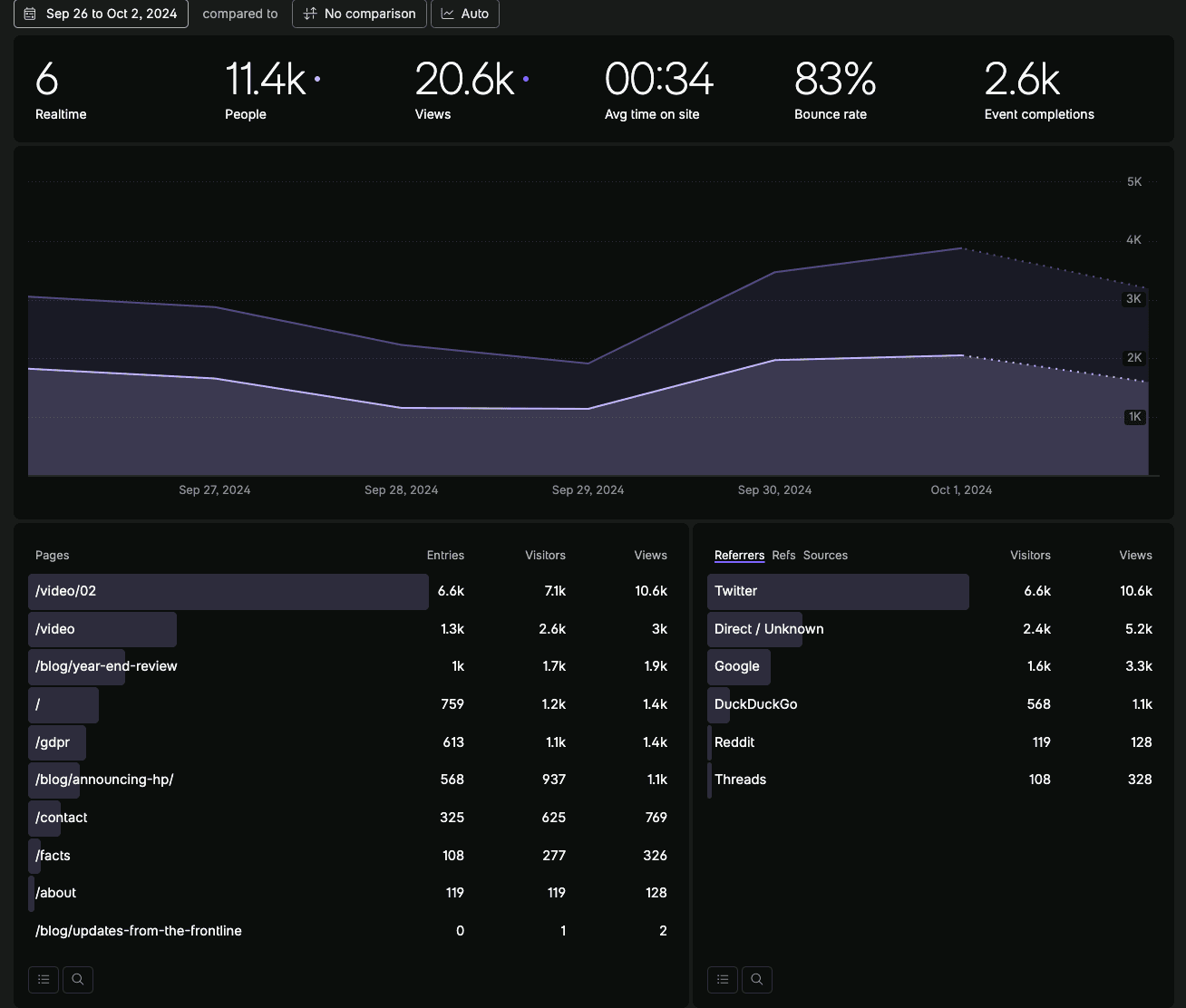
Fathom is a privacy-focused Google Analytics alternative. It is a simple web analytics tool that captures details on traffic, sessions, referrers, sources, and campaigns. It does this while helping users stay compliant and avoid cookies.
Key features
Simple web analytics: Fathom provides a simple, GA-like experience to monitor your website.
Cookieless: Avoid cookie banners and track your site without using cookies.
Marketing metrics: Track the sources, devices, browsers, locations, UTMs, and more for your traffic.
Conversions: Track custom events and analyze them as conversions towards a goal.
How does Fathom compare to Matomo?
Fathom, like Plausible, has a much simpler feature set than Matomo. It focuses on providing the core web analytics features in a privacy-friendly way.
Main differences between Fathom and Matomo
- Fathom is closed-source and cloud-only; Matomo is open source and self-hostable.
- Fathom is cookieless by design; Matomo uses cookies by default.
- Fathom has no session replay, heatmaps, or A/B testing; Matomo offers all three.
- Fathom has a minimal single-page dashboard; Matomo has GA-style multi-page reporting.
Main similarities between Fathom and Matomo
- Both are privacy-focused Google Analytics alternatives
- Both track pageviews, visitors, referrers, UTM campaigns, and conversion goals
- Both integrate with Google Search Console for SEO data
- Both support Google Analytics data import for easy migration
💡 Good to know: Fathom isn't entirely EU hosted, but instead attempts to stay compliant with European regulation by:
- Being a Canadian company. The European Commission determined that Canada has an adequate level of data protection.
- Having EU isolation so visitor data is routed and stored on EU servers.
- Having a data processing agreement (DPA) available.
Why do companies use Fathom?
Fathom has limited reviews on G2, but much more praise on social. The reasons people seem to choose Fathom are:
Privacy focus: Fathom reviewers almost always praise their focus on privacy. This allows users to stay compliant with regulations like GDPR, CCPA, and more.
Ease of use: Reviewers find Fathom is simple to set up and simple to understand. Less technical users find this especially helpful.
Migration from GA: Thanks to both its Google Analytics importer and its relatively similar interface, reviewers find the migration from GA to Fathom relatively easy.
Bottom line
If you are looking for a simple, privacy-friendly web analytics tool, Fathom is one to consider. It lacks a free tier, but does offer a trial.
8. Umami
- Founded: 2022
- Similar to: Plausible, Fathom
- Typical users: Developers and content-focused teams
- Typical customers: Small devs and large content-focused enterprises
What is Umami?
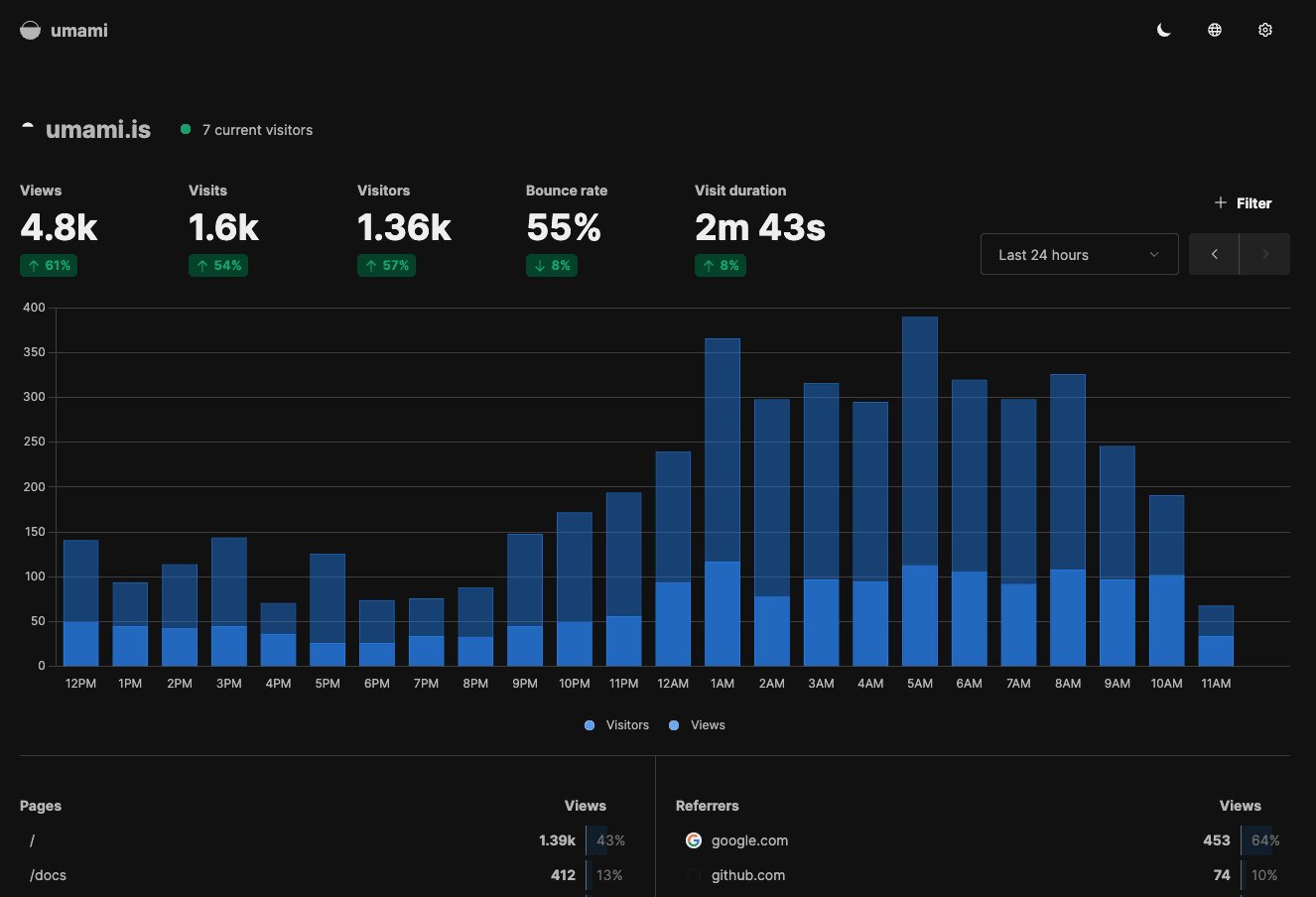
Umami is an open source, easy-to-use Google Analytics alternatives. Like other similar tools, it is privacy friendly. This means data is anonymized, no personal data is saved, you don't need a cookie banner, and comply with GDPR.
Key features
Visitor insights: Breakdown the sources of your traffic. See the browsers, locations, devices, and OS they use.
Custom events: Track more than pageviews. Capture custom events wherever they happen on your site.
Open source: See all of the code, run and host it yourself, modify it for your needs, and contribute to it.
Realtime: Get a view into the live stats for your site. See how many current visitors you have.
How does Umami compare to Matomo?
Umami, like Plausible and Fathom, focuses on web analytics. Unlike those two alternatives (and Matomo), it has a free tier. It lacks the full feature set of Matomo however.
Main differences between Umami and Matomo
- Umami has a free cloud tier (3 sites, 100k events/month); Matomo Cloud starts at $29/month.
- Umami has no A/B testing; Matomo does. Both tools have session replay and heatmaps, but both are on paid Cloud tiers.
- Umami is simpler to self-host and maintain; Matomo On-Premise requires more setup and plugin management.
- Matomo has a larger plugin ecosystem and more integrations; Umami is intentionally lean.
Main similarities between Umami and Matomo
- Both are open source and self-hostable
- Both use cookieless tracking by default
- Both track pageviews, referrers, UTM campaigns, and custom events
- Both are GDPR-compliant
- Both offer EU hosting options
Why do companies use Umami?
According to its few G2 reviews and mentions on social, users choose Umami because of:
Simple setup: Reviewers find that Umami is easy to setup, self-host, and add to their site.
Free plan: Users appreciate they can use Umami for 3 sites and 100k events for free.
Design: Umami's clean and simple UI gets brought up as a selling point for some reviewers.
Bottom line
Umami is very similar to other alternatives on this list, with the big upside that it is open source, easy to self-host, and free. This makes it a good choice for privacy-conscious, web analytics users.
Which Matomo alternative should you choose?
- Need more than web analytics – like session replay, A/B testing, feature flags, and error tracking? PostHog goes far beyond pageviews and won't cost you a thing to start.
- Want a near-identical experience to Matomo with a free cloud tier? Umami is the closest match.
- Looking for simple, privacy-first web analytics with no setup overhead? Plausible or Fathom keep it minimal.
- Enterprise team in a regulated industry needing consent management and strict compliance? Piwik Pro is built for that.
- Need GA-style product analytics with autocapture and minimal engineering involvement? Heap is worth considering.
- Heavily invested in Google Ads, BigQuery, and the Google ecosystem? Google Analytics is hard to beat for marketing attribution.
Is PostHog right for you?
Here's the (short) sales pitch.
We're biased, obviously, but we think PostHog is the perfect Matomo replacement if:
- You want all the tools to help you build a better product (like product analytics and A/B testing).
- You value transparency. We're open source and open core.
- You want to try before you buy. We're self-serve with a generous free tier.
It's completely free to get started – no credit card required. Our setup wizard handles configuration in minutes, or you can check out our docs to do it yourself.
Install PostHog with one command
Paste this into your terminal and make AI do all the work.
Frequently asked questions
PostHog says it makes your product "self-driving" – what does that mean?
It means PostHog digs through your product data, finds what's worth fixing, and has agents do the work.
It starts with context. A full suite of developer tools – AI Observability, Product Analytics, Session Replay, Feature Flags, Experiments, Error Tracking, Logs, and more – captures everything happening in your product, and a Context Warehouse unifies it into one source agents can read across.
From there, Scouts read across all of it and sort what's worth knowing from what's just noise. What clears the bar becomes a report in your inbox: an agent picks it up, roots out the cause, and opens a PR. You review and merge.
You can steer it from Slack, the web app, the desktop app, or your own editor via the MCP or CLI.
What is Matomo used for?
Matomo is a privacy-first web analytics platform used to track website traffic – pageviews, sessions, referrers, campaigns, and conversions – with full data ownership. It's popular with content publishers, government agencies, universities, and e-commerce sites that need GDPR compliance without using Google Analytics. Advanced features like session recording, heatmaps, and A/B testing are available as paid add-ons.
Is Matomo really free?
Matomo On-Premise is free to download and self-host. But "free" comes with caveats: you're responsible for hosting, maintenance, and updates. Most of the features that make Matomo compelling beyond basic web analytics – session recordings, heatmaps, A/B testing, funnels, and cohorts – are premium paid plugins on On-Premise, priced annually per plugin. Matomo Cloud starts at $29/month.
For a broader look at options, see our guide to the best open-source analytics tools.
What's the best free Matomo alternative?
PostHog offers the most complete free tier: 1 million analytics events, 5,000 web and 2,500 mobile session replays, 1 million feature flag requests, 100k error tracking events, and more per month – no credit card required.
Umami offers a free cloud tier for 3 sites and 100k events.
What's the best Matomo alternative for privacy?
Plausible and Fathom are the strongest options for lightweight, cookieless web analytics with no personal data collection. PostHog and Matomo itself both support EU hosting, cookieless tracking, and HIPAA compliance for teams with more complex requirements. Piwik Pro is the best choice for regulated industries needing built-in consent management.
Can I migrate from Matomo to PostHog?
Yes. See our Matomo to PostHog migration guide for step-by-step instructions.
What are the best web analytics tools in 2026?
The top web analytics tools in 2026 include PostHog, Matomo, Plausible, Fathom, and Google Analytics 4.
The right choice depends on your privacy requirements, technical setup, and whether you need standard web metrics or deeper product analytics. See our full guide to the best web analytics tools.
What are the best open-source analytics tools?
The top open-source analytics tools include PostHog (MIT license), Matomo (GPL v3), Plausible (AGPL), and Umami. PostHog is the most feature-complete, combining web analytics, product analytics, session replay, feature flags, and more.
See our guide to the best open-source analytics tools.

Subscribe to our newsletter
build mode
Read by 75,000+ founders and builders
We'll share your email with Substack
PostHog is your product's context layer. With a full suite of developer tools – AI observability, product analytics, session replay, feature flags, experiments, error tracking, logs, and more – PostHog ingests and stores all the data agents need to diagnose problems, uncover opportunities, and ship fixes. A data warehouse and CDP tie it all together, unifying that context into one source agents can read across. You can steer it all from Slack, the web app, the desktop (PostHog Desktop), or your own editor via the MCP.