







Product engineer vs software engineer: How are they different?


Contents
Software companies were once dominated by two types of roles: product managers and software engineers, but this is changing. A new role is emerging: the product engineer.
Want proof? Look at this graph:
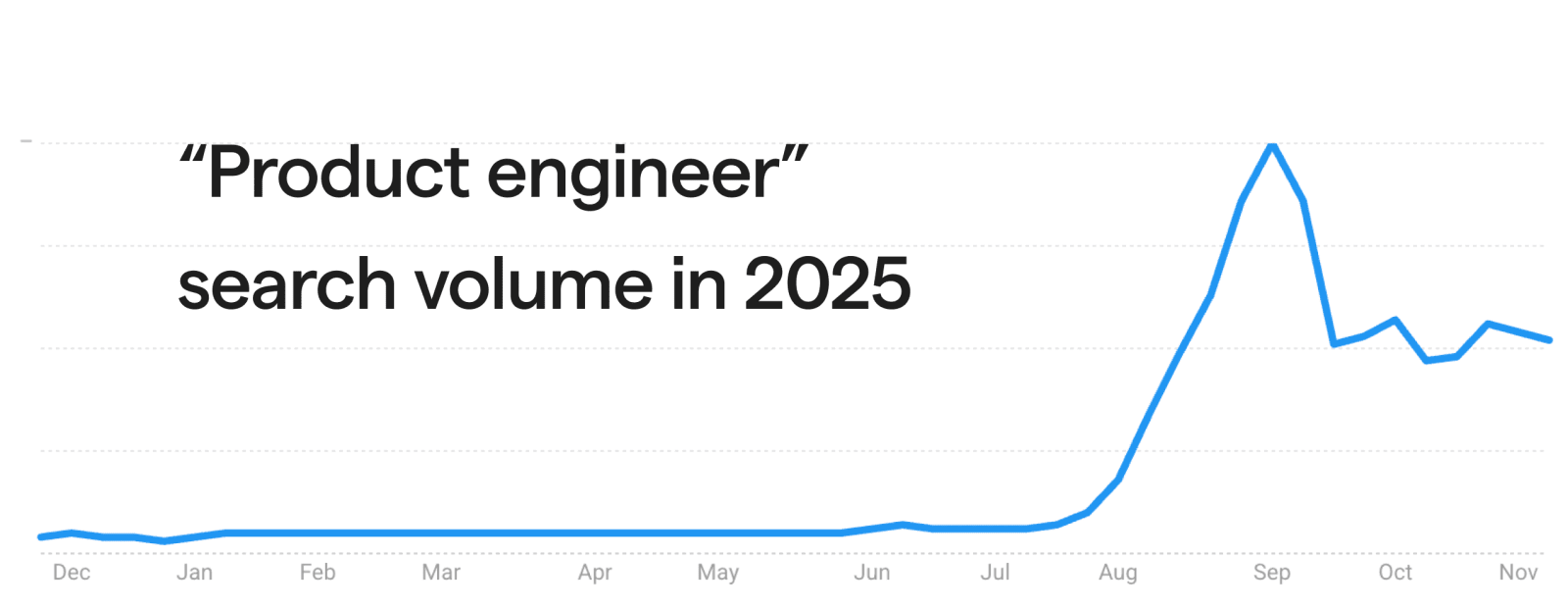
Online searches for product engineers have grown by 89% since 2021 as startups like ourselves, incident.io, and Ghost, prioritize engineers who are customer-obsessed, talk to users directly, and comfortable working autonomously.
Product engineers are changing the way companies think about engineering. To explain why, we’ll compare the role of product engineer with the traditional (and still very necessary) role of the full-stack software engineer.
TL;DR – Product engineers focus on building great products while software engineers focus on building reliable software. Both of them write code, but with different priorities in mind.
Wait, what about growth engineers? A growth engineer is a type of software engineer who focuses on projects that drive growth metrics like signups, subscriptions, and revenue. They share many characteristics with product engineers, but have a broader focus on growth across the company rather than a specific product.
How are product and software engineers different?
Product engineers – sometimes referred to as product-minded engineers – "own" the product and are responsible for its successes and failures. They're empathetic towards users and care about solving their problems. They build with the user in mind and create what users need to succeed.
In contrast, software engineers "own" the code they write. They care more about solving technical problems, optimizing systems, and writing clean code. Since they focus more on the implementation, they usually aren’t the ones making product decisions (they rely on product managers for that).
What are their priorities?
The top priority of a product engineer is to solve users' problems.
They build fast, even from scratch if needed, and then iterate. The tradeoffs they consider go beyond technical constraints and include more holistic factors like the user experience, business deadlines, and product roadmap. In this way, they tend to be more pragmatic.
Software engineers prioritize the ideal technical solution.
They look for the best solution to the problem in front of them, focus on best practices, and build on prior work. This means they're usually more specialized and idealistic. Their projects often involve more backend and system design work, and they're constantly thinking about optimizing security, reliability, and scale.
How do they spend their time?
Product engineers still spend the majority of their time coding, but they have responsibilities outside of coding that software engineers don't.
Product engineers talk to customers, dig into usage data, and research the competitive landscape. They test other products, build prototypes, and brainstorm experiments to make their product better. They use this research to prioritize a roadmap that they own, and take responsibility for explaining the roadmap and gathering feedback from users and the company.
Product engineering also tends to be more fast-paced, scrappy, and independent than software engineering. This is especially true as AI coding tools are on the rise; product engineers can use LLMs to quickly move features from 0->1 without getting bogged down by implementation details.
Software engineers code too (of course) but they also spend lots of time designing, testing, and maintaining what they build. They look for ways to optimize systems, improve scalability, and solve bugs. They are deeply focused on specific areas of technology, whether those are databases, data pipelines, backend APIs, or client-side app frameworks.
Software engineering projects also move slower because, as specialists, they must collaborate cross-functionally. A software engineering team might include a frontend engineer, backend engineer, tester, designer, and product manager. A product engineering team usually includes just product engineers.
Why is demand for product engineers growing?
There's no single reason, but it's often simply because companies want to ship faster. Product engineers are popular among startups and early-stage companies for this reason, even if they don’t say it. Many software engineers at these companies behave like product engineers, even if it's not their job title.
For example, Linear, the wildly popular modern project management tool, is built almost entirely by product engineers. Instead of hiring PMs, small teams of product engineers speak directly with customers and own product roadmaps. When the person talking to users is the same one writing the code, less time gets spent on handoff. Product engineering teams can also make product decisions on the spot since there's no need to cover what's technically feasible first.
At larger companies, product engineers are less common, but they do exist. They're often seen as a way to drive innovation and inject urgency through smaller teams that have more freedom to ideate and execute independently. For example, at the time of writing, Microsoft is hiring for a team of "Product Engineers to help build the Copilot web experiences" – a high velocity project in a huge enterprise organization.
Finally, as more dev tool companies emerge, demand for product engineers will continue to grow (after all, developers understand developers best). Startups like Vercel and PostHog are always seeking product engineers with "a strong passion for developer experience" who can "think like a product builder".
Is product engineering right for you?
Good product engineers need to:
- Be customer-obsessed.
- Enjoy talking directly to users.
- Care deeply about outcomes and impact.
- Be flexible about exact implementation.
- Thrive in fast-paced environments.
If that sounds like fun, then product engineering might be for you.
If, however, you want to focus on solving difficult technical problems and optimizing existing technologies and processes, then more traditional software engineering roles are a better choice.
Just remember that product engineering is more a way of working and thinking than a defined, rigid role. Product engineers should be flexible enough to go deep on technical implementation when needed. Likewise, software engineers can choose to adopt a "product engineer" mindset whenever they like.
When should companies hire product engineers?
Product engineers are ideal for startups and companies that want to be agile and move fast, such as B2B SaaS or consumer subscription services. They take a holistic view of the product and have the ability to ship quickly when needed. They're less effective for companies with large, technically complex products like infrastructure platforms for large enterprises.
Picking what's right is up to the company and its goals. If you're a small team focusing on building great products, multi-skilled product engineers who can talk to users are a great choice. If your larger product requires specialization to scale and maintain, software engineers are the better choice. Companies with both types of roles have succeeded, and more will continue to succeed.
Further reading
- What is a product engineer (and why they matter)
- Startups, stop treating engineers like a different species
- The really important job interview questions engineers should ask (but don't)
- WTF is a forward-deployed engineer? (and why everyone is hiring them)

Subscribe to our newsletter
build mode
Read by 75,000+ founders and builders
We'll share your email with Substack
PostHog is your product's context layer. With a full suite of developer tools – AI observability, product analytics, session replay, feature flags, experiments, error tracking, logs, and more – PostHog ingests and stores all the data agents need to diagnose problems, uncover opportunities, and ship fixes. A data warehouse and CDP tie it all together, unifying that context into one source agents can read across. You can steer it all from Slack, the web app, the desktop (PostHog Desktop), or your own editor via the MCP.