







The most common questions about developer marketing, answered

Contents
One of the baffling things about leading the marketing team at PostHog is how often I get asked for advice. People seem to look at PostHog and say "Wow, they have billboards across San Francisco, they must really know what they're doing" — but that's not how it feels on the inside.
There is no grand unified theory of marketing, here or anywhere else. Anyone who pretends otherwise is lying to you. Best I can figure, the only thing that makes marketing at PostHog different is that we're more transparent about this than most. And I've never even been to San Francisco!
Regardless, I keep getting asked to hop on quick calls with founders and developers to talk about marketing. I'm always happy to chat, but I thought it would be helpful to write down the answers my thoughts on the most common questions I get. All of it comes with the caveat that these are just my thoughts and that marketing at PostHog is a team effort.
"I built something and told people about it. What should I do now?"
Tell them again, probably.
Developers often treat a launch as a single event: you post it on Hacker News or Product Hunt, write a big X announcement, and then get back to building. But one launch is never enough. A launch is the start of the work, not the end of it.
When we were repositioning PostHog, we had the idea that every marketing message should land in three places, in three different ways. So launching our Slack agent, for example, didn't just go in the changelog one time — it also got a video and an automation that recommends it to users on our startup program. Like every launch we do, it got a GitHub issue which extended past the initial launch moment to include pre- and post-launch tactics.
Marketing at PostHog is like creating a piece of art: it never gets finished, just abandoned.
"What channels should I use?" / "What channels work?"
The short answer is an unhelpful "It depends".
The long and still unhelpful answer is "It depends what you're good at."
Non-marketers expect channel advice to be tiered somehow: start with small stuff like social posts, then graduate to medium stuff like events, then big stuff like billboards, then prestige stuff like TV. In reality you can use any channel whenever you want, they all take a lot of work to do well, and you should move between them based on what you can do best and what you can do authentically.
"What you can do best" just means leaning into your strengths. At PostHog, we didn't decide to build a newsletter because we thought it was the only channel that mattered, we were just writers who knew how to do that well. A big reason we lean so hard on writing is that James simply wrote a lot early on, it worked, and we went from there — other startups aren't so lucky. If we were a group of former TV executives, we'd have done something different.
"What you can do authentically" is harder to define, but is something you should know intuitively. If a channel doesn't feel like an authentic extension of your brand or your internal culture, listen to that. At PostHog we don't avoid webinars and gated whitepapers because those channels are ineffective — it's just that we think they're kind of lame and don't feel very PostHoggy.
"New users don't know about old features. What should I do?"
Oh my gosh, same. It's a real challenge for us too. PostHog does so much and we spend all our time talking about it, but somehow there are still people who think we're a self-hosted product analytics tool.
Two things I find helpful to bear in mind:
- It is often more effective to upgrade an existing user than acquire a new one, and
- Small gains compound, so don't overlook them.
Usually this means investing in your onboarding flows as a way to educate users about existing features as well as new ones. I've written elsewhere about what PostHog's email onboarding looks like and we're increasingly taking those lessons into other channels too, such as in-app messaging or the Wizard. It helps that onboarding at PostHog is unusually long — the flow sends a lot of emails over a long period of time, which gives us plenty of chances to introduce features a user hasn't touched yet.
Existing users who are long past onboarding need different surfaces, though. For them we send a monthly announcement email rounding up everything we've shipped, and we cross-sell other products in-app when someone's usage suggests they'd benefit from one they aren't using yet.
"How can I communicate small improvements without creating spam?"
Spam is a content or a targeting problem, not a volume problem. If your content is good enough and users can be targeted well enough, you could message them every day and be fine. With this in mind: talk to your users and ask them what content they would find valuable from what channels, when.
They're unlikely to tell you good solutions, but they're very likely to tell you what the problems are.
Not every improvement needs its own announcement, though. We batch small changes into the changelog, and save dedicated emails for things that change how someone actually works. Always question if an email actually needs to be sent before you send it.
"People are lazy. If people just searched/prompted, they would find my thing"
This might not be a marketing problem. Are you sure you're solving a problem that people actually need solved?
"How do you approach showing up in LLMs (AEO)?"
I do whatever Nat tells me to do.
"How do I market products that haven't launched yet?"
We call that pre-marketing. It's something I've specifically focused on this quarter, as you can see from my current goals. The basic system is:
- A public roadmap so people can see what we're building, or thinking of building.
- A way for them to sign up to a waitlist and self-serve into available betas.
- Automations informing users on a waitlist when something moves to alpha or beta.
- Automations asking users for periodic feedback on alphas or betas.
- Automations relaying this feedback to the relevant team internally.
- A way for users to pitch new ideas into the roadmap, which get surfaced internally.
Beyond this we also use some regular marketing surfaces, such as the monthly changelog email and onboarding emails, to highlight particular betas we're excited about.
We don't run paid marketing for betas. I've been game for trying it, but our biggest betas often change shape dramatically as we work on them so the messaging becomes very challenging.
"What data do you track to know you're successful?"
This sometimes surprises people, but the marketing team at PostHog is not often very data-led. I think this stems from my early career as a journalist, where I was mentored to chase good stories over better metrics. There are definitely other team leads (like Andy and Ian) who are more attuned to the data than I am — but, again, there is no single unified theory here.
This isn't to say we are data-blind, however. Marketing is responsible for new user sign-ups and we track that figure and a few others closely. But where we can, we prefer to judge the success of things by other factors, like "Did users say they enjoyed this?" and "Do we want to do this again?"
At a previous startup I worked at we discussed this a lot. Leadership wanted a metric to track the ROI of product marketers and required us to log how we spent time in 15 minute intervals. As a result, perverse incentives emerged and people started spending more time in meetings where work was collaboratively performed, but little was done.
At PostHog, we take the opposite approach and treat data, like AI, as a tool to use when appropriate, not as the go-to solution for every problem.
"How can we build a community around our product?"
I get asked this surprisingly often given that community is something I don't think we've historically done very well. Maybe that's because it's never clear what people mean by 'community'. Is it a packed event calendar, your volume of social media mentions, the general vibe from your customers, or something else entirely?
Some of these things, like in-person events, PostHog does really well now. But we didn't always. The very first event we ever put on cost $10,000 to host and took me weeks to organize — but in the end only six people showed up and one of them was a personal friend. My attic was full of leftover merchandise for months. It was a disaster.
Afterwards, we did what we always do after a failure: we ran a post-mortem to discuss it without assigning blame. Looking back, here's what I learned about community at PostHog:
You must be able to clearly define what your community is. We jumped to launching this event because we had a busy public Slack channel and people kept saying they liked our community. If we'd have taken a cold, hard look, we would have realized that we didn't have a community at all, but just a tech support forum. This would have led us to invest more in building our support team earlier, rather than trying to host fireside chats.
I am not personally good at events. Seriously, I panic at the idea of organizing my own birthday parties. I had to push against myself to make it work. The timing wasn't quite right either, but we also needed an expert who could open events as a channel for us authentically.
"Who should I hire as my first marketer?"
I'm incredibly biased, but I do think product marketers are the best first marketing hire for early stage teams.
Product marketing managers — or product marketing meddlers, if you prefer — focus on the most pressing issues for early stage teams, such as how to position your product in a marketplace, and how to translate marketing strategies into things users actually care about. In my experience product marketers are also very T-shaped and can pick up a wide variety of tactical work too. The best ones tend to be good at lots of things.
That said, hiring a marketer isn't something to rush into. None of PostHog's first five hires had ever done marketing before and it would have been far more damaging to hire the wrong person early on than to go without a positioning statement for a few months.
"How do you track ROI for your campaigns?"
I personally do not care about, or track, the money we make very much. It's a tremendous privilege of working at PostHog that I can say this, but I prefer to focus on things that are worth doing or interesting for reasons other than profit.
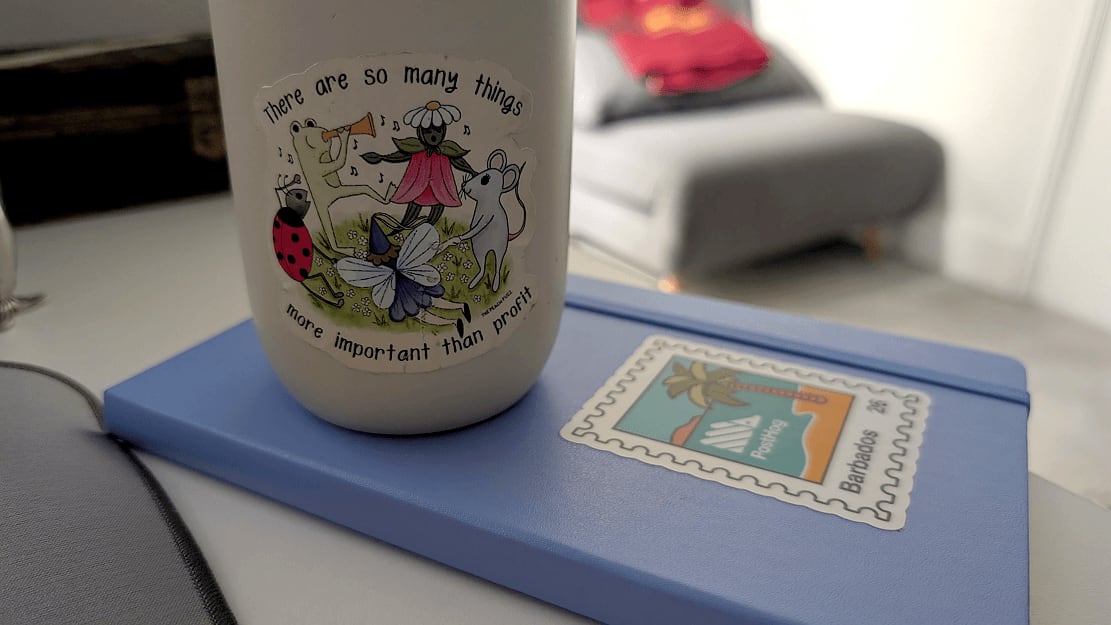
If anything, the PostHog marketing team is often under pressure to spend more money. If you want to make more money, all I can say is: try charging more, or try spending money to make money.
"OK, but what about those billboards?"
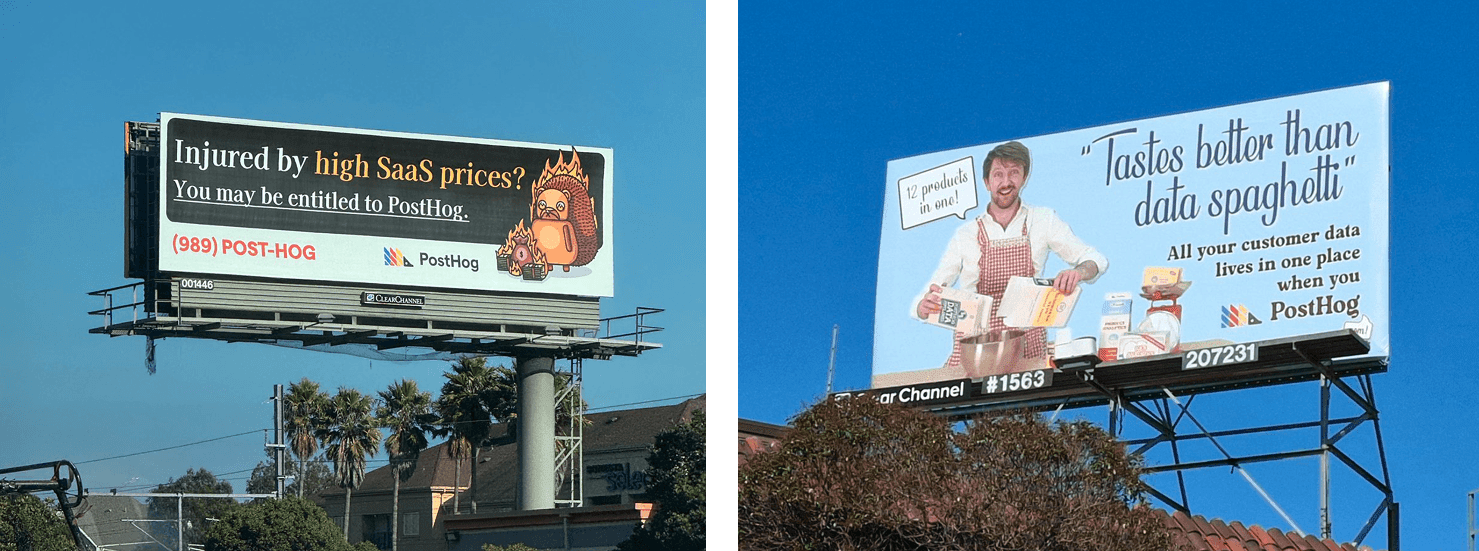
We did the billboards initially as an experiment. It felt like a channel we could have a lot of fun with and that fit our strategy, so we gave them a go. People seem to really like them, so we keep doing more and the old billboards get recycled into merch.
People often ask how we measure the performance of the billboards, but that's kind of missing the point. They are not a channel that drives sign-ups. They are a channel that drives awareness. The measure of success isn't being able to tie an enterprise deal to a placement — it's seeing if people like them and talk about them. We measure that by listening.
"You do great merch. How do you justify that and what suppliers do you use?"
Thanks! We put a lot of effort into merch.
Our merch doesn't really exist to be profitable. It exists to spark joy. Justifying its existence isn't a matter of figuring out the ROI, it's a matter of whether we have confidence in the concepts. It helps that we have an incredibly stylish and talented graphics team who design everything in-house.
In terms of suppliers, we have tried many over the years. Currently we work with Micromerch. Much of our clothing stock is sourced from AS Colour or Stella & Stanley and, until recently, most of the modelling was done by our team because we thought that would be fun. That's me in the Scrabble t-shirt, for example!
"What am I missing?" / "What advice do you have?"
One: Don't succumb to all the same influences and self-help business books as everyone else and expect to learn anything new. I learned more about marketing reading Masters of Doom and hanging out with artists than I did going to marketing conferences.
Two: Take a chance hiring young or unusual people when you can. Same reasoning: you're never going to create something original by hiring people with tired, predictable playbooks. Plus, it's an unalloyed Good Thing!
Three: Start every marketing decision by asking "Does this feel right for our culture?" because everything comes back to that eventually anyway.
Four: Orwell's sixth rule applies to all of the thoughts above.
"Shouldn't this have been a Reddit AMA or something?"
Maybe, IDK.
PostHog is your product's context layer. With a full suite of developer tools – AI observability, product analytics, session replay, feature flags, experiments, error tracking, logs, and more – PostHog ingests and stores all the data agents need to diagnose problems, uncover opportunities, and ship fixes. A data warehouse and CDP tie it all together, unifying that context into one source agents can read across. You can steer it all from Slack, the web app, the desktop (PostHog Desktop), or your own editor via the MCP.