







How Legit Media fixed their broken marketing reports with PostHog Endpoints
Jun 24, 2026
Contents
Legit Media runs a network of news websites across Africa reaching 70+ million readers a month. On top of that audience, they sell paid online courses in copywriting and digital marketing, using their news brands as the distribution channel.
Growing those course subscriptions is a performance marketing operation: paid campaigns running across multiple channels, geographies, and individual specialists at once. The marketing team's weekly reports (which include spend, CPA, conversion rates, upsells, broken down by channel and country) are what drives every budget decision. When those reports stopped arriving reliably, their marketing team was making decisions in the dark.

The API that cried busy
Legit's weekly marketing reports pull PostHog data alongside Facebook ads data, sliced by advertising channel, geographic market, and individual marketing specialist. The queries aren't light, including week-over-week breakdowns with multiple joins and filters running across a full volume of subscription events.
They were calling the PostHog API directly, but the size of the queries was causing the API to time out, and it kept telling them it was busy.

About 1 out of 7 requests was successful. Before switching to Endpoints, during the last few weeks we weren't able to get any reports at all — the API was constantly responding that it was too busy and couldn't process our requests.
The marketing team was waiting for reports that never arrived, and trying to piece things together manually by jumping between PostHog dashboards.
Found Endpoints, fixed in a few hours
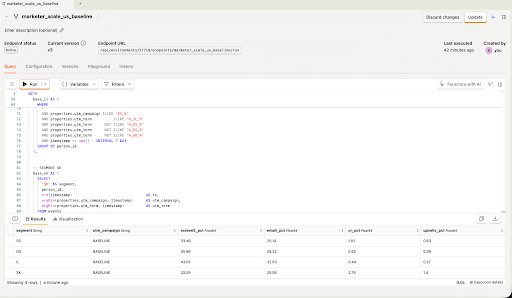
Legit's CTO went back to the PostHog documentation and found Endpoints. The idea clicked immediately: instead of raw API calls that had to fight for availability each time, Endpoints wrap SQL queries into stable, callable URLs that are purpose-built for this kind of programmatic access.
They tried it. It worked. The first report was live in a few hours. Today Legit runs 7 PostHog Endpoints. They sit inside an n8n automation workflow that pulls data from both PostHog and Facebook Ads, then consolidates everything into a single report table.
The underlying queries filter by UTM campaign, UTM term, GEO, and group results by person. This kind of multi-layered breakdown previously caused the raw API to buckle.
The requests started to be processed much faster, and the response stability improved significantly.
No more hunting for numbers
Reliability improvement is one thing. But the bigger change is what the marketing team does with their time now.
Before, pulling the weekly report meant manually navigating across multiple PostHog dashboards, copying numbers, and assembling a picture of performance by hand. Now this time is spent analyzing and optimizing their campaigns and growing revenue more effectively.
Previously, marketers had to manually gather all this information from different PostHog dashboards. After automation, everything is now consolidated and available in a single place, and they spend their time analyzing the results instead of searching for the right data.
PostHog is the leading platform for building self-driving products. With a full suite of developer tools – AI observability, product analytics, session replay, feature flags, experiments, error tracking, logs, and more – PostHog captures all the context agents need to diagnose problems, uncover opportunities, and ship fixes. A data warehouse and CDP tie it all together, unifying that context into one source agents can read across. You can steer it all from Slack, the web app, the desktop (PostHog Desktop), or your own editor via the MCP.