







The best web analytics tools for developers, compared

Contents
A lot web analytics tools hand you a pageview count and a dashboard you can't get your data out of, with a chunk of that traffic lost to ad blockers.
If you're a developer, the tools below are the ones worth your time.
Beyond basic traffic reporting, they autocapture pageviews and clicks so you're not hand-instrumenting every interaction, expose your raw data through SQL or an API instead of trapping it in the UI, survive ad blockers with reverse-proxy and cookieless tracking, and plug into the rest of your stack.
The right pick ultimately comes down to what you care about most:
- If you want traffic and in-app behavior in one platform: PostHog
- If you care most about privacy and a tiny footprint: Plausible
- If you want the simplest setup possible: Fathom
- If you live inside Google Ads: Google Analytics 4
- If you need to own your data: Matomo
- If you are a solo developer just running a small or personal site: Umami
What's the best web analytics tool for developers overall?
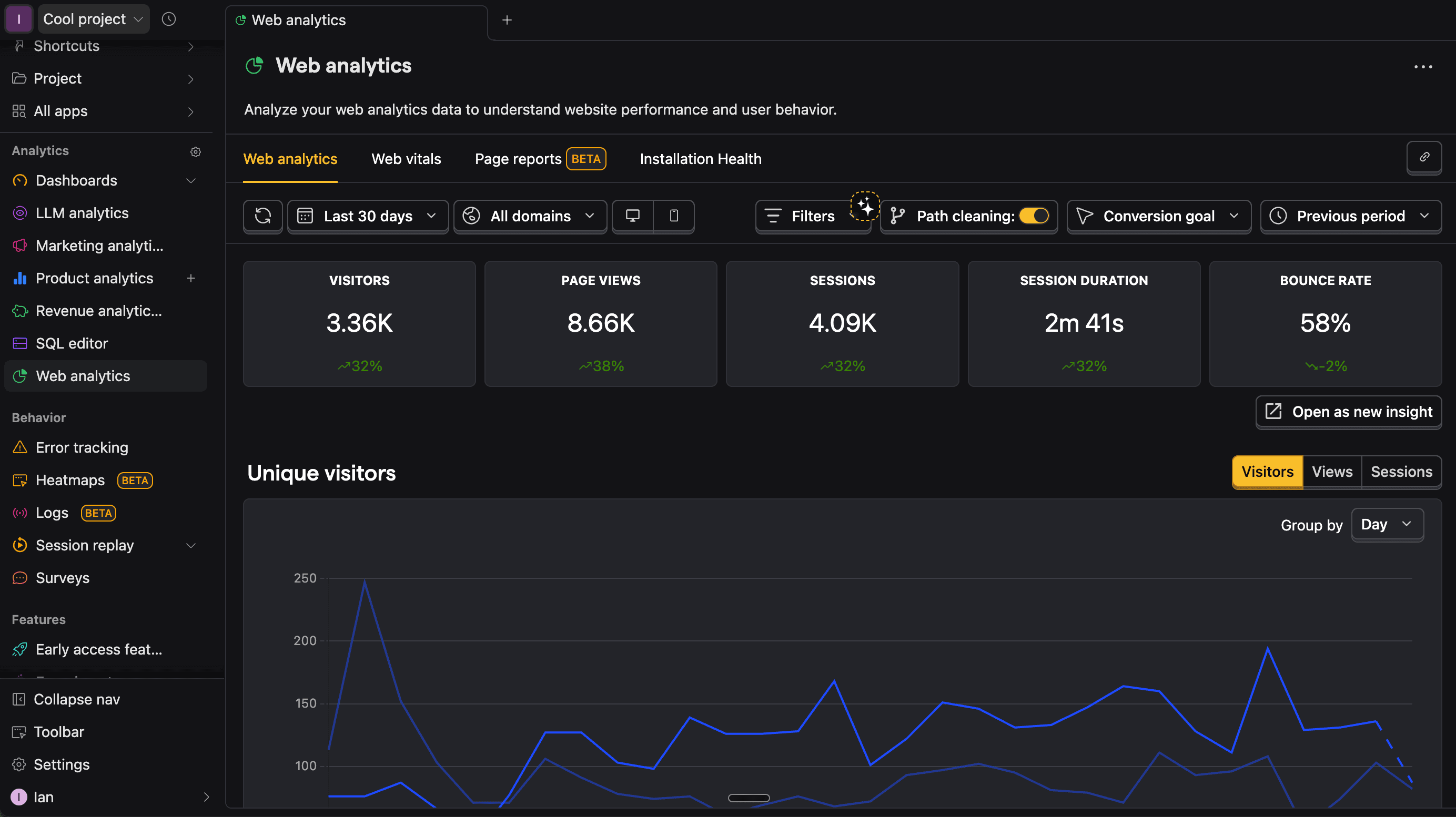
For most teams, the best web analytics tool is PostHog. Most analytics tools only tell you a visitor showed up; PostHog keeps going, because web analytics lives in the same platform as product analytics, AI observability, session replay, feature flags, and a lot more.
You get a proper MCP server for querying your data straight from your editor, plus transparent, usage-based pricing with a generous free tier.
It also makes your product self-driving.
What makes PostHog good for developers:
- Install: One
posthog-jssnippet, the package for your framework, or let the setup wizard handle it - Capture: Autocapture for pageviews and clicks, plus custom events, heatmaps, web vitals, and more
- Data access: SQL, REST API, the MCP server, and data warehouse exports
- Privacy: Cookieless option and reverse-proxy support so ad blockers don't gut your data
- Pricing: Transparent and usage-based, with credits for eligible startups
- License: Open source (MIT)
Not ideal if: All you'll ever want is a bare visit counter with nothing else attached – that's more platform than you need.
Alternatives to consider: Plausible if you truly only want a single-purpose tracker; GA4 if you live inside Google Ads.


Install PostHog with one command
Paste this into your terminal and make AI do all the work.

What's the best web analytics tool for privacy?
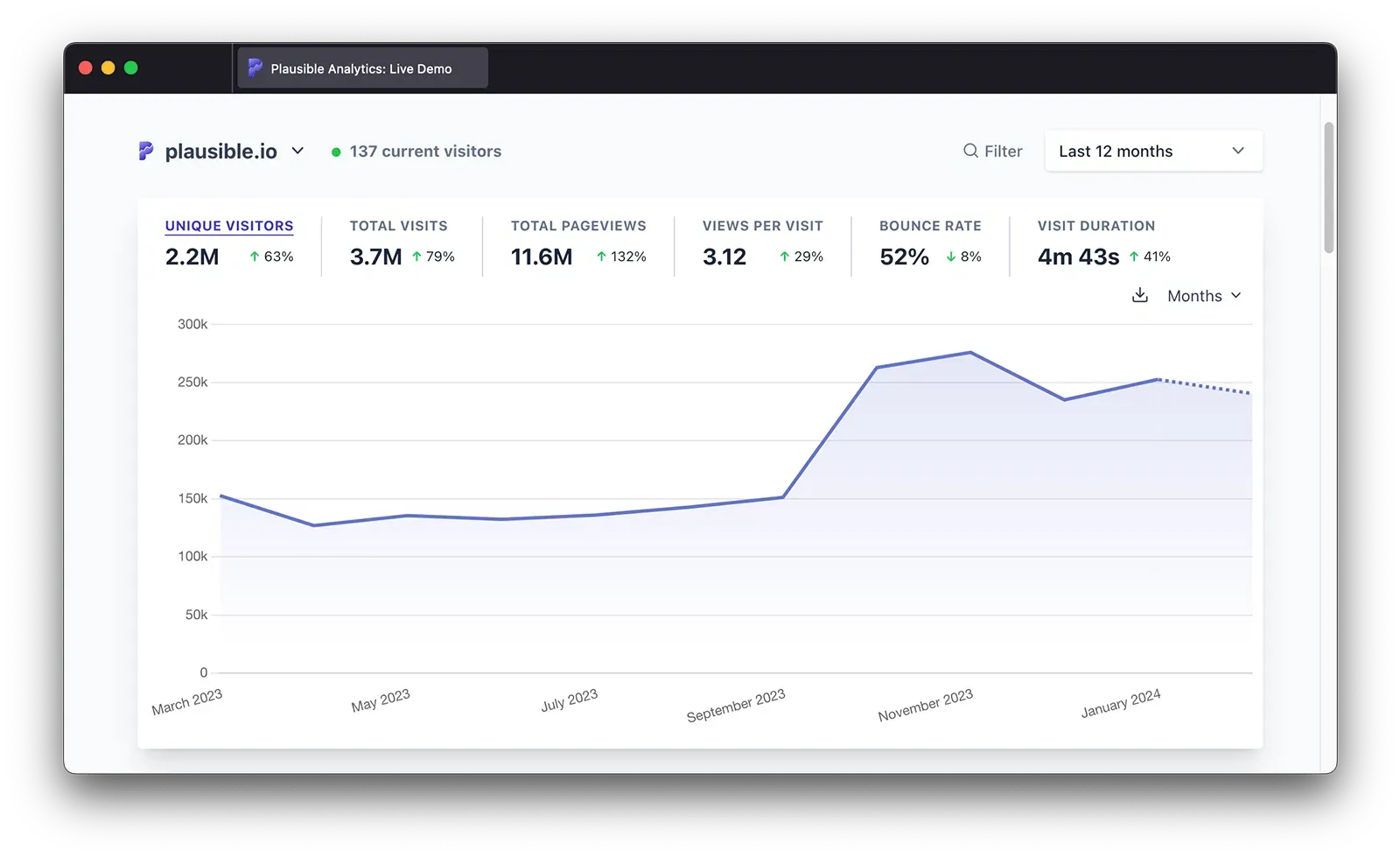
Plausible is the go-to for privacy: cookieless by default, GDPR- and CCPA-friendly, and no cookie banner required. It's a lightweight, open-source tool that offers readable traffic reporting with nothing to configure.
What makes Plausible good for developers:
- Install: Single
<script>tag (~1 KB) or npm package - Capture: Automatic pageviews; custom events set up manually
- Data access: Stats API for pulling your numbers
- Privacy: Cookieless by default, no cookie banner
- License: Open source (AGPL v3)
Not ideal if: You need to connect traffic to what users actually do next, since it's traffic-only by design.
Alternatives to consider: PostHog if you want a more comprehensive view of user behaviour and don't want to wrangle multiple tools; Fathom for a near-identical hosted option.
What's the best web analytics tool for the simplest setup?
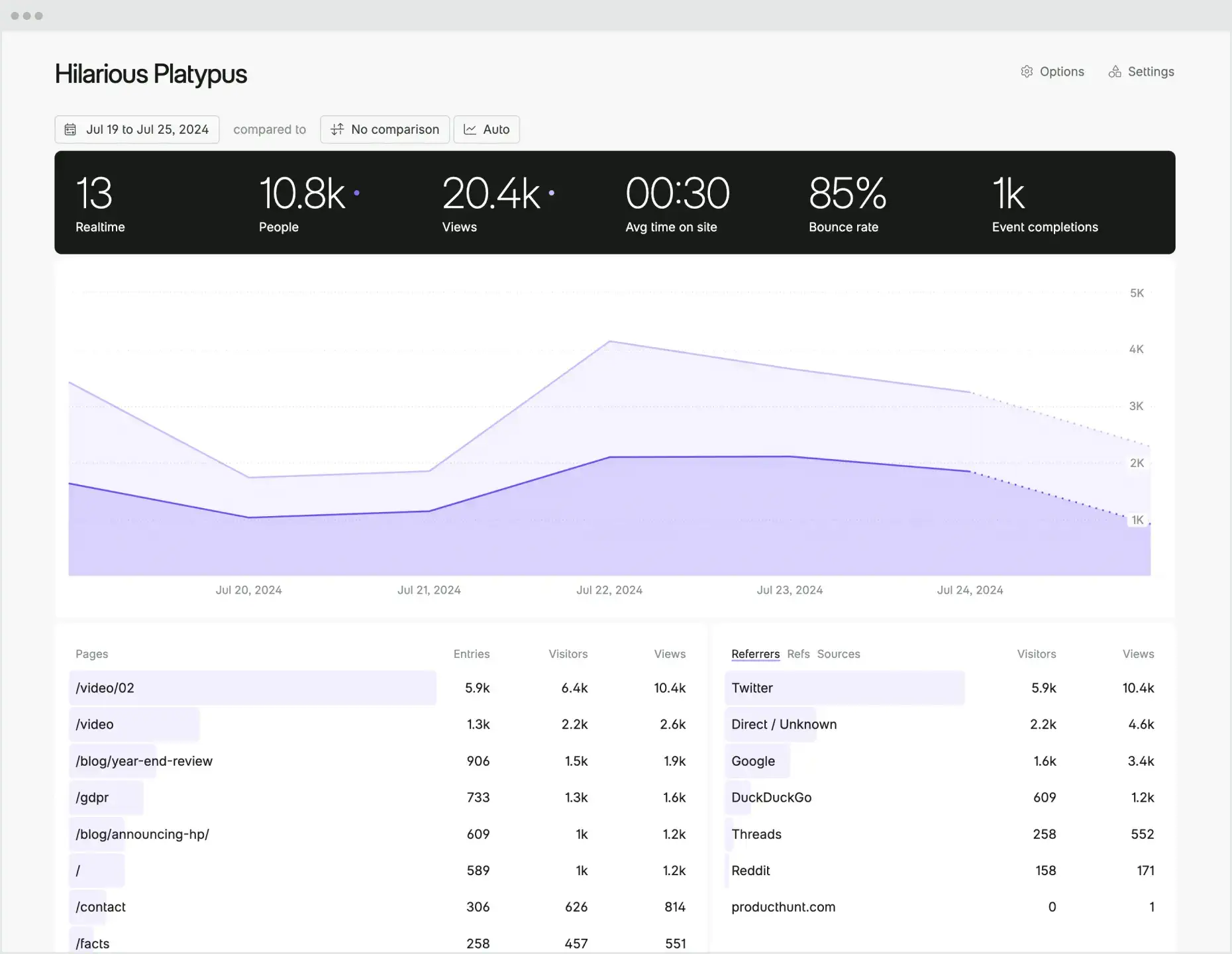
Fathom is the fastest to get running: drop in one script and you have clean, privacy-safe traffic data with no configuration. It strips web analytics down to the essentials and stays out of your way.
What makes Fathom good for developers:
- Install: Single
<script>tag; custom domain to slip past ad blockers - Capture: Automatic pageviews plus manual event tracking
- Data access: REST API
- Privacy: Cookieless, GDPR/CCPA-friendly by default
- License: Proprietary (the old Fathom Lite was open source)
Not ideal if: You want funnels, retention, or any behavioral data beyond traffic.
Alternatives to consider: Plausible is the obvious head-to-head pick.
What's the best web analytics tool for Google Ads users?
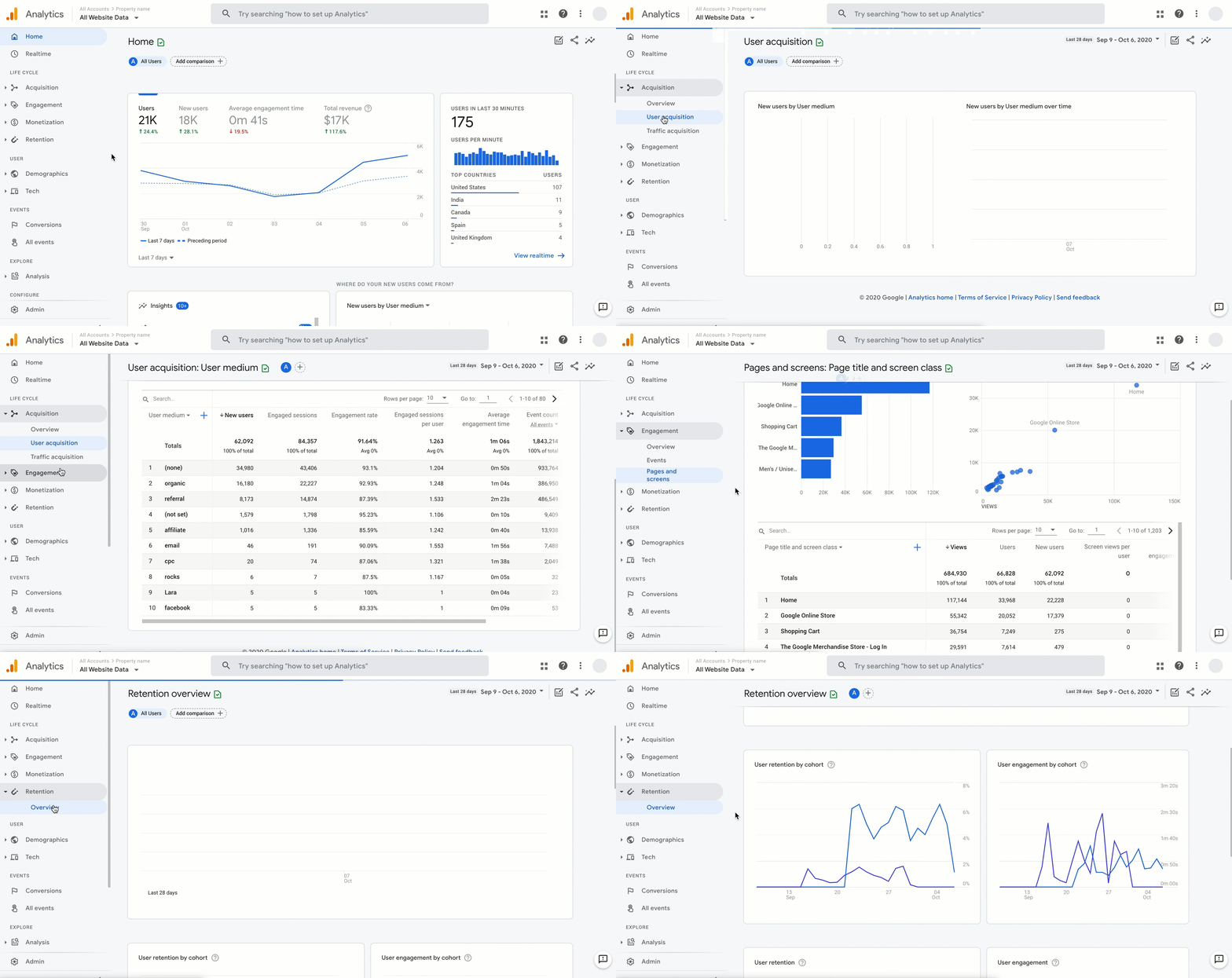
Google Analytics 4 is the natural pick if you live in Google Ads; it's free and wired directly into Google's ad and search ecosystem. The tradeoff is the learning curve and traffic data that stays siloed from product behavior.
What makes Google Analytics 4 good for developers:
- Install:
gtag.jssnippet or Google Tag Manager - Capture: Enhanced-measurement auto-events plus custom events
- Data access: Free BigQuery export for raw events and the Data API – but reports sample above high thresholds
- Privacy: Cookie-based with Consent Mode; IP addresses aren't stored
- License: Proprietary
Not ideal if: You want something quick to learn and developer-friendly.
Alternatives to consider: PostHog for a friendlier, developer-first tool that also connects to product data; Plausible if you want simple and private instead of sprawling.
What's the best web analytics tool for data ownership?
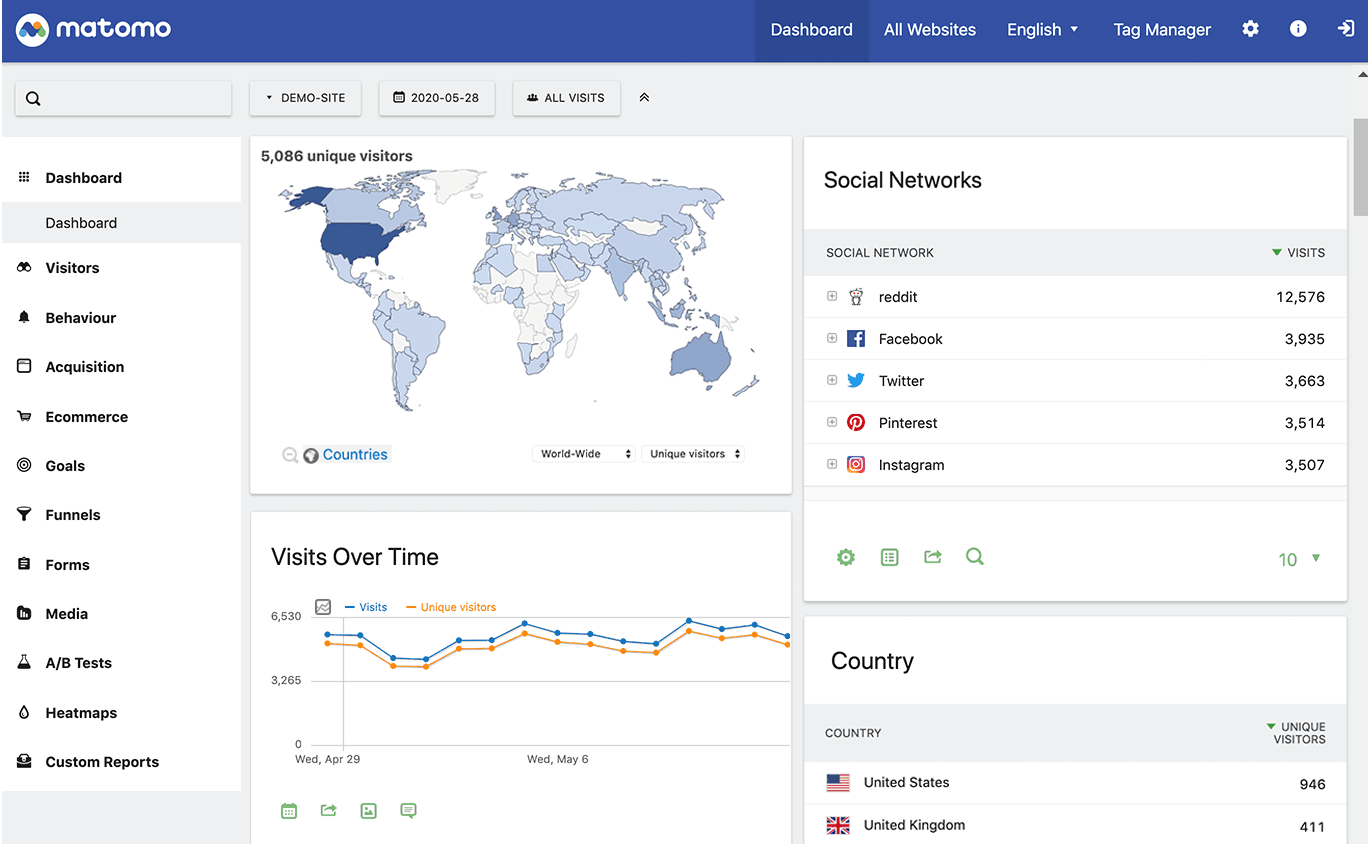
Matomo is the best choice when owning your data matters most. It's a feature-rich GA alternative that keeps your analytics out of Google's ecosystem and adds extras like heatmaps and recordings.
What makes Matomo good for developers:
- Install: JS tracker, server-side, or import from server logs
- Capture: Pageviews and events; heatmaps and recordings as add-ons
- Data access: Reporting API plus direct access to the raw data
- Privacy: Cookieless mode available; GDPR tooling built in
- License: Open source (GPL v3)
Not ideal if: You'd rather not manage a heavier, feature-dense platform.
Alternatives to consider: Plausible if Matomo feels like more than you need.
What's the best web analytics tool for small and personal sites?
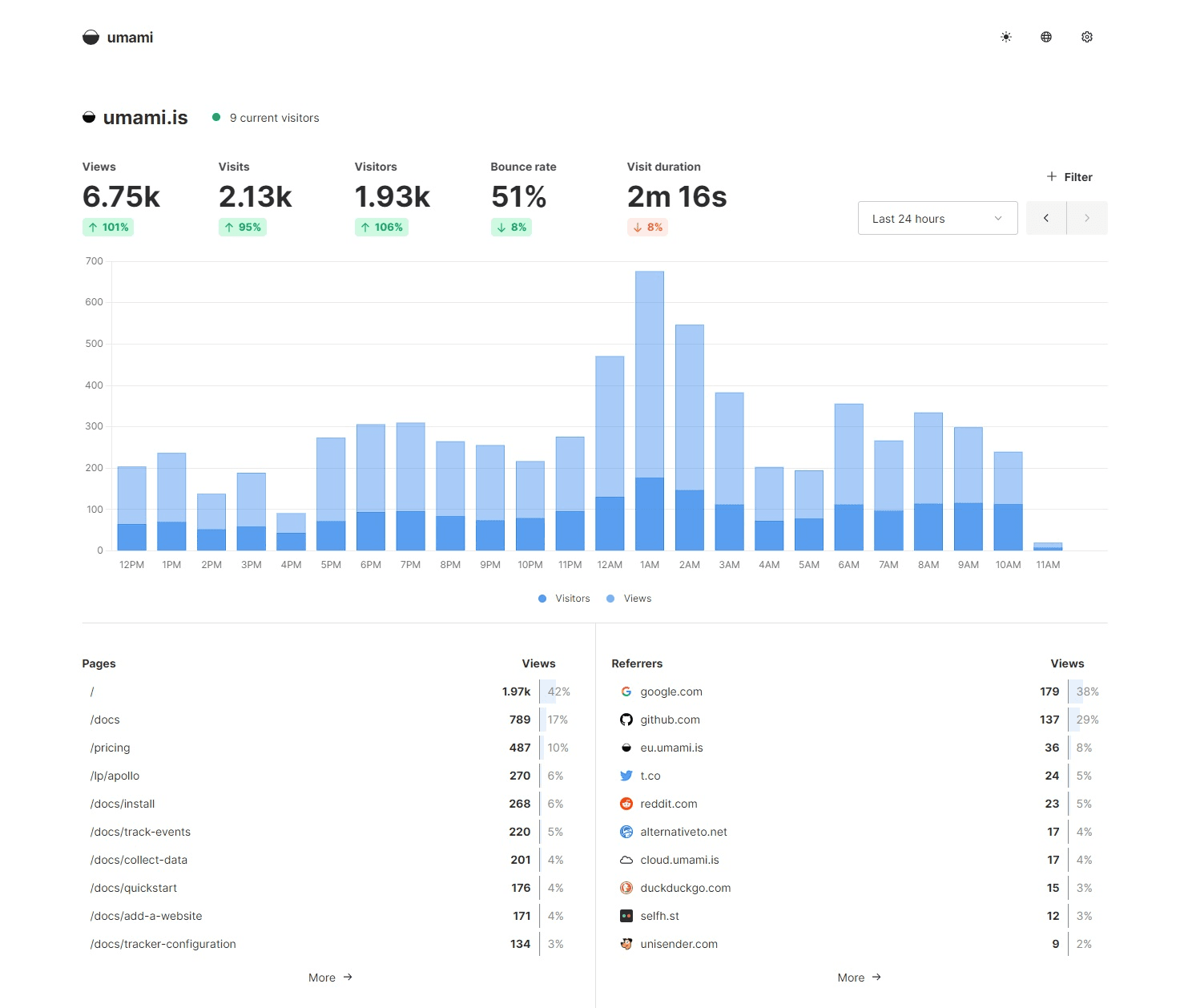
Umami is the tidiest option for a small or personal site: minimal, open-source, and fast, with a single clean dashboard. It gives you the basics and nothing you'd have to think about.
What makes Umami good for developers:
- Install: Single
<script>tag; runs on Node + PostgreSQL/MySQL - Capture: Automatic pageviews plus custom events
- Data access: REST API
- Privacy: Cookieless, no consent banner needed
- License: Open source (MIT)
Not ideal if: You need anything beyond basic traffic counts.
Alternatives to consider: Fathom for a hosted equivalent you don't have to manage.
Other frequently asked questions
How is PostHog different from other web analytics tools?
Every tool on this list shows you data. A self-driving product acts on it for you – and it's the direction PostHog is built around.
Instead of you digging through dashboards to find what's worth fixing, PostHog does the digging. A full suite of tools – web analytics, product analytics, session replay, feature flags, experiments, error tracking, and more – captures what's happening in your product, and a Context Warehouse unifies it into one source agents can read across.
From there, Scouts sort what's worth knowing from the noise. What clears the bar lands in your inbox as a report – then an agent picks it up, finds the cause, and opens a PR for you to review and merge. You can steer it all from Slack, the web app, the desktop app, or your editor via the MCP or CLI.
No other tool here does that.
What's the best free web analytics tool?
Google Analytics 4 is free and the most widely used, while PostHog has a generous free tier, and open-source tools like Umami and Matomo are free to run yourself.
What's the best Google Analytics alternative?
For a lightweight, privacy-first swap, Plausible and Fathom are the popular picks. If you want more than traffic numbers, PostHog is the strongest alternative, since it replaces GA and your product analytics tool at once.
How does PostHog compare to Google Analytics 4?
GA4 is free and deeply tied into Google's ad ecosystem, but its event model and interface have a steep learning curve, and it keeps traffic data separate from product behavior.
PostHog is friendlier to developers and connects web analytics directly to product analytics, replays, flags, errors, and a lot more, so you see not just where traffic came from but what it did. You can even sync your Google Ads data into PostHog. Teams leaning on Google Ads may want GA4 alongside it; most others can consolidate on PostHog.
For a more in-depth comparison, visit our PostHog vs Google Analytics 4 comparison guide.
Are there open-source web analytics tools?
Yes. PostHog, Plausible, Matomo, and Umami all offer open-source editions, so you can inspect the code and own your data.
What's the best cookieless web analytics tool?
Plausible, Fathom, and Umami are cookieless by default, and PostHog supports cookieless tracking too – all good options for avoiding cookie banners.

Subscribe to our newsletter
build mode
Read by 75,000+ founders and builders
We'll share your email with Substack
PostHog is your product's context layer. With a full suite of developer tools – AI observability, product analytics, session replay, feature flags, experiments, error tracking, logs, and more – PostHog ingests and stores all the data agents need to diagnose problems, uncover opportunities, and ship fixes. A data warehouse and CDP tie it all together, unifying that context into one source agents can read across. You can steer it all from Slack, the web app, the desktop (PostHog Desktop), or your own editor via the MCP.