







6 things I've learned in 6 years at PostHog

Contents
After 6 years at PostHog, I am delighted to share that I have learned exactly 6 things.
80% of being a good manager is good hiring
The other 20% is giving context and getting out of the way. If you hold an extremely high bar when you're hiring, it genuinely makes everything else much easier, even if it feels like you're saying no to everyone and are never going to find the right person.
Whenever I have managed a first-time manager at PostHog, the first thing I ask them to do is less. A lot of people assume that they need to transform into some inauthentic corporate drone once they adopt the lofty mantle of management, but the reality is most of the work is done up front, when you hire the right person. If you've hired good people, then your job is about giving them the context they need to do their jobs.
Of course there is occasional conflict or performance management to deal with, but a) that is a tiny part of the job, and b) if you are doing a lot of it, you or someone else probably hired badly in the first place. You cannot hire badly and then extremely hands-on manage them into being good.
Despite knowing this, you will relax your standards for that one hire, then regret it. You will keep re-learning this lesson, but hopefully with longer gaps between each one. It is 1,000x easier to say no at the interview stage than to let someone go later.
Never underestimate the power of an internal meme
Memes are not just funny images – they can be a devastatingly effective way of communicating information, especially as your company grows.
Here are a few things that were really important to our strategy, but spread far more effectively when dressed up in meme form:
- Our graphics team wanted to spend a quarter on more systems-focused work and improving what we already have, vs. spending too much time on shipping net new stuff. We called this Serious Summer and it made it much easier to know whether to say yes or no to something.
- Hitting $100m ARR is fine as a target. But hitting The Hundy has become PostHog lore at this point (355 mentions in Slack and rising), and you see people genuinely asking "How can we help hit the hundy?"
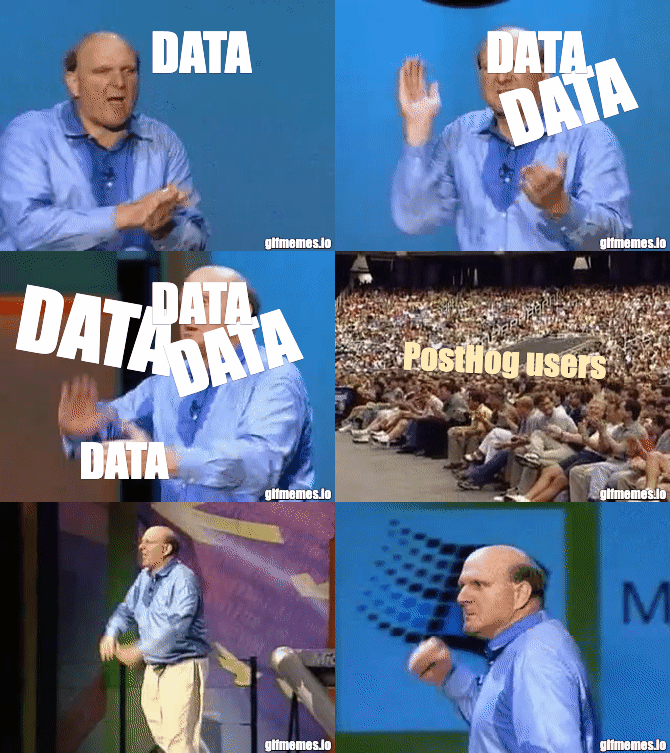
- We want PostHog to be known for making it easy to reliably capture and use data from your product from a positioning perspective. But Steve Ballmer has made this point much more effectively in GIF and Slackmoji form, and we frequently use him when product teams are thinking about what to build next. Thanks Steve.
Your competition is TikTok, not your competitor's lame blog
When it comes to attention on the internet, you are competing with Shorts of capybaras eating watermelon, not some dry blog about "2026 trends in midmarket ELT adoption". Aim higher – when it comes to doing better than most corporate blogs, the bar is basically in hell.
I've found that if what we're doing is not actually funny – aka "corporate try hard" – then it's not good enough. At one point we realized we were getting too cutesy ("ooh a hedgehog"), which isn't interesting enough for people outside PostHog, even if we think it's cool, so we dialed it down.

This is why we encourage our team to be rogue/sarcastic/meme-y/unhinged/weird. Our competitors are (i) more defensive and self-interested in their approach (focused on optimizing revenue growth), and (ii) more boring. We believe that if we have fun, we'll stick it out longer and win in the long term.
"What got you here won't get you there" is BS
I think that scaling startups sometimes use this as a lazy excuse to drift from their core mission or culture because they look at other, larger, more successful companies and think "we should imitate them".
There's a long list of things that got us here and are still getting us there, including:
- Small teams scale extremely well. One of the best things we've ever done is to keep engineering teams to six people or fewer.
- Talking to users. Our assumptions about what they want and how they might use our product may have changed. Actually, they definitely have. You can only partially outsource this to reading brand mentions and LLM summaries of sales call transcripts.
- Going upmarket doesn't mean neutering your brand; enterprises are full of real people too who like to read fun stuff.
- Selling features over benefits works surprisingly well upmarket too. Sometimes people at giant corporations really do just want "a tool that does X".
- People will tell you hiring technical people to sell software does not scale beyond the first handful. This is not true, it's just hard.
If you find yourself saying "we need to do things differently", think about whether you are doing it because you believe it from first principles, or because you're copying other cool-looking companies (who, by the way, always look way more impressive online than on the inside).
Doing merch well is really freaking hard
Moving physical stuff around the world is difficult, and it doesn't surprise me that every software company struggles with this.
If you want to do it cheaply, it will feel cheap, and no one will want to wear it. If you want to do it expensively (you should), suppliers will be harder to find, lead times for literally everything will be longer than you like, and your logistics provider will disappoint you time and time again. Until you find Micromerch – happy to recommend them.
Don't do merch for the sake of it – make things that you would actually use or enthusiastically recommend yourself. When my wife told me "I think you need to wear less PostHog merch", I knew we'd made it.
Treat merch like a proper marketing channel, and give it a significant budget and an owner. For years merch drifted as an unwanted problem between people at PostHog until we solved for these two things.
Price accordingly in your merch store, even if it is designed to give away for free. If I see a hoodie for $30, I will assume it is poor quality.
To get good at writing, do more reps
The more you write, the better you will get at it and the more you will enjoy it. Make as much of your thinking as public as possible, as this is the best way to get direct feedback and do better next time. Share your monthly list of priorities, write a blog post, write on LinkedIn, write for yourself, and just stick it in Slack.
Use the same words you use when you're talking. Don't use jargon if you wouldn't say it in real life. Write like a normal human being talking to other human beings. For some reason, managers think they need to start using corporate-speak to signify their managery-ness.
Don't use qualifiers. If you think X isn't good, say "I think X is not good", not "I kinda think" or "I'm not sure X is right".
Explain the why. If you ask a question or have a thought, explain where it has come from. Genuine curiosity? Great! Have a concern? Say that! Don't make people second guess, as you're just adding to their mental load.
Make time to write. If something needs a thoughtful response, use "Save for later" (in Slack) or create a task for yourself. You don't need to respond immediately, just indicate you've seen it. It's fine to say "let me think about this and get back to you".
PostHog is your product's context layer. With a full suite of developer tools – AI observability, product analytics, session replay, feature flags, experiments, error tracking, logs, and more – PostHog ingests and stores all the data agents need to diagnose problems, uncover opportunities, and ship fixes. A data warehouse and CDP tie it all together, unifying that context into one source agents can read across. You can steer it all from Slack, the web app, the desktop (PostHog Desktop), or your own editor via the MCP.